Dr Samuel Furse » 2011 » December

 Biological Signalling Thursday, Dec 22 2011 

The approach of determining the lipid composition of living systems, called lipidomics [1], has demonstrated that a huge number of lipids are present in living systems.  Recent publications showing this in sharp focus include reports of the complete lipidome of part of the murine (mouse) immune system [2] and human plasma [3].  What this work shows, is that there are over 500 distinct molecular species distributed amongst the established lipid categories.  Reasoning would suggest that this is a large number of lipid types for the physical job of producing a cellular membrane (despite the need for several types of lipid in order produce a cellular membrane).

This begs the question: what are the remaining lipids for?  It is tempting to believe they have no function, however evolution suggests that this possibility is unlikely in nature, i.e., what evolutionary advantage would there be to produce lipids that are of no use?  What is far more likely is that there is a function.  And indeed this turns out to be the case.

Several of the minor lipid components of these systems are known to be biological signals.  Inositides are the dominant example of this.  One member of this group, called PIP3, forms part of the system that manages the release of insulin from the β-cells of the islets of Langerhans [4].  However, there is also much evidence [5] that PIP3 is also involved in the activation of a protein called PKB.  This protein is an enzyme that phosphorylates other proteins, activating them.  Enzymes that phosphorylate are called kinases, hence PKB: Protein Kinase B.  This enzyme, or more specifically, the phosphorylation it performs, is at the heart of the body’s control of growth.  It is therefore similar to the sort of signalling systems that go wrong in diseases such as cancer.

The research into PIP3 has been seen as important, and the development of an understanding arising from them, significant. This lipid has even been prepared using synthetic organic chemistry [6], such that sufficient stock of this lipid is available for further research. However, the fact that this lipid has proved to be so important in biological systems has made the other seven inositides rather more attractive than they once were. Thus, attention is now turning towards them. Phosphatidylinositol itself is the precursor to all other inositides. Kinase activity similar to that elicited by PKB turns phosphatidylinositol into inositides such as the phosphatidylinositol phosphates. There are three types of phosphatidylinositoldiphosphate head group, but only one phosphatidylinositoltriphosphate. Although no signalling role has been discovered for phosphatidylinositol, what has been discovered is that it can have a pronounced effect on the curvature of the lipid system of which it is part [7].

The demonstration of a pronounced effect on membrane curvature and an important biological signalling role for lipids that are closely related chemically is a bewildering thought. Are inositides an unappreciated force in vivo?

References

[1] E. A. Dennis, Proceedings of the National Academy of Sciences, 2009, 106, 2089–2090. http://www.pnas.org/content/106/7/2089.full.pdf+html?sid=e68904de-d625-41e0-aa17-cc9a36be94c2

[2] E. A. Dennis, R. A. Deems, R. Harkewicz, O. Quehenberger, H. A. Brown, S. B. Milne, D. S. Myers, C. K. Glass, G. Hardiman, D. Reichart, A. H. Merrill, M. C. Sullards, E. Wang, R. C. Murphy, C. R. H. Raetz, T. A. Garrett, Z. Guan, A. C. Ryan, D. W. Russell, J. G. McDonald, B. M. Thompson, W. A. Shaw, M. Sud, Y. Zhao, S. Gupta, M. R. Maurya, E. Fahy, and S. Subramaniam, Journal of Biological Chemistry, 2010, 285, 39976-39985. http://www.jbc.org/content/285/51/39976.full.pdf+html?sid=1a75f1d7-9661-4fc8-af76-cd29dd1cc326.

[3] O. Quehenberger, A. M. Armando, A. H. Brown, S. B. Milne, D. S. Myers, A. H. Merrill, S. Bandyopadhyay, K. N. Jones, S. Kelly, R. L. Shaner, C. M. Sullards, E. Wang, R. C. Murphy, R. M. Barkley, T. J. Leiker, C. R. H. Raetz, Z. Guan, G. M. Laird, D. A. Six, D. W. Russell, J. G. McDonald, S. Subramaniam, E. Fahy, and E. A. Dennis, Journal of Lipid Research, 2010, 51, 3299-3305. http://www.jlr.org/content/51/11/3299.full.pdf+html?sid=a1eb540d-d814-47ad-b102-455aeb3852b2

[4] O. I. Hagren and A. Tengholm, Journal of Biological Chemistry, 2006, 281, 39121-39127. http://www.jbc.org/cgi/doi/10.1074/jbc.M607445200

[5] B. A. Hemmings, Science, 1997, 277, 534. http://www.sciencemag.org/content/277/5325/534.full

[6] P. R. J. Gaffney and C. B. Reece, Journal of the Chemical Society, Perkin Transactions 1, 2001, 192-205. http://pubs.rsc.org/en/content/articlelanding/2001/p1/b007267m

[7] X. Mulet, R. H. Templer, R. Woscholski and O. Ces, Langmuir, 2008, 24, 8443–8447. http://pubs.acs.org/doi/full/10.1021/la801114n.
 Lipidomics Thursday, Dec 15 2011 

One of the big questions in biology is how living organisms work. How do we stay alive?  Understanding of this over the last two centuries has led to the development of science into the chemistry that sustains life in biological systems.  This is what biochemistry is.  A recent approach to understanding living systems has been to work out what all the genes are in a given organism.  This is all the genome is: all the genes an organism possesses.  Knowing what the genes are is useful because it tells us which proteins can be made. These proteins go on to do a variety of things, like speeding up digestion (enzymes), or for making the machinery required for cells to control what passes through their membrane (e.g. ion channels, which you may have read about here).  Genes and cataloguing the genome is an important advance in science, but it does not tell us everything. 

It is also useful to understand the range of other components present in a system, such as the lipids.  Knowing the complete lipid profile, the lipidome, of a system is particularly informative.  The word lipidome may seem unfamiliar, but it is the lipid equivalent of the genome in genetics, that is, a catalogue of every lipid in a given species. 

Once we know which lipids are present, and how much, we can use published evidence of the individuals’ behaviour to make conclusions about the relationship between what we observe in vivo.  Physical evidence from biophysical studies, such as the use of x-rays to determine the topology of the self-assembly in lipid systems [2], is also used to inform the understanding of these systems.  Lipidomics [1] is a relatively new approach to understanding the lipid fraction of biological systems.  In physical terms, it allows us to re-construct the system from the known behaviour of its parts. This is a more fundamental approach that is perhaps superior than simply doing things to lipid systems to find out what happens, such as adding chemicals that disturb the forces that hold lipid systems together.  Such chemicals are celled chaotropes [3,4,5]. 

Lipidomics sounds remarkably easy. We know what we need to do, and there are just a couple of steps to achieve it. We have a problem, however. Isolating these lipid molecules is more difficult than for proteins or DNA. Certainly adding solvents to dissolve the lipids makes sense, but this is awkward if we consider the relationship lipids have with water, and particularly so if they are more like a surfactant (i.e. soap) than a lipid.  This has not stopped tenacious lipid chemists from using sophisticated solvent systems to extract lipid fractions from plant, animal, or fungal material [6], however.  But this on its own is not enough.  Current lipidomics methodology also uses mass spectrometry to identify the molecules according to their molecular mass.  If this is accurate enough, it can be used to determine the number and identity of the atoms present.  This in turn is used to pin down the lipids’ identity. 

If this approach is applied to a whole organism, such as Saccharomyces cerevisae [6], the species of yeast used in baking bread and making beer, the results produce a lipidome of that species.

The lipidome tells us about the range of lipids the system is capable of producing, and does produce, which then informs us about the range of physical behaviour of membranes in the system.  The most exciting thing about this, in my opinion, is that we might then be able to understand the role of lipids in cell division.  How we get from one cell membrane to two is a physical process, but without an understanding of the lipid component we cannot construct a picture of how this happens on a molecular level.  Once we do, the understanding of lipids in a system will be at the same level as that of DNA and proteins.

References

[1] M. R. Wenk, Nature Reviews, 2005, 594, 594-610. http://staff.washington.edu/mwhiddon/Wenk%20et%20al.pdf
[2] X. Mulet, R. H. Templer, R. Woscholski, O. Ces, Langmuir, 2008, 24 , 8443–8447. http://pubs.acs.org/doi/abs/10.1021/la801114n
[3] K. Kinoshita, M. Yamazaki, Biochimica et Biophysica Acta, 1997, 1330, 199-206.
[4] G. C. Shearman, S. Ugazio, L. Soubiran, J. Hubbard, O. Ces, J. M. Seddon, and R. H. Templer, Journal of Physical Chemistry B , 2009, 113, 1948–1953. http://pubs.acs.org/doi/abs/10.1021/jp807998d
[5] Y. Feng, Z. W. Yu, P. J. Quinn, Chemistry and Physics of Lipids ,
2002, 114, 149–157. http://www.kcl.ac.uk/kis/schools/life_sciences/life_sci/quinn/publications/cpl114.pdf
[6] C. S. Ejsing, J. L. Sampaio, V. Surendranath, E. Duchoslav, K. Ekroos, R. W. Klemm, K. Simons and A. Shevchenko, Proceedings of the National Academy of Sciences, 2009, 106, 2136-2141. http://www.pnas.org/content/early/2009/01/27/0811700106 .

 Curvy Biology Friday, Dec 9 2011 


There is no such thing as a straight line in nature. This is especially obvious in cells and in their membranes. The absence of straightness from biological systems, including that of bilayers, presents a problem for membrane biophysicists and lipid chemists. Although the principles governing the way the lipid molecules used by cells to make membranes are well understood for flat bilayers, the presence of curvature provides an additional dimension to what we see. However, as with a lot of science, it gets a little bit more complicated before it gets simpler.


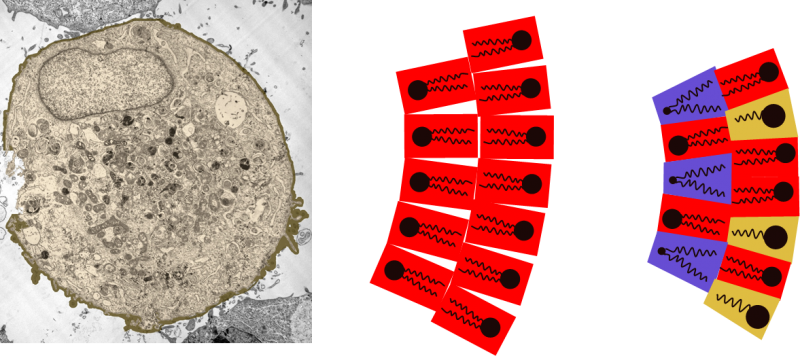
Figure 1. Curvature in membranes. (a) Prostate cancer cell, taken by Robyn Schlicher of Georgia Institute of Technology, showing normal curvature of all membranes; (b) A bilayer of phosphatidylcholine, showing that this lipid cannot form a curved surface as this would require vacuums in between the lipids; (c) The inclusion of cone-shaped lipids into a PC bilayer allows the layers to produce a curved surface without a vacuum.


Figure 2. Curvature in membranes arises through lipids of differing shapes. Left is the type II phosphatidylethanolamine, that gives rise to negative curvature. In the middle is the type 0, cylindrical, phosphatidylcholine that does not induce any curvature. On the right is lyso-phosphatidylcholine that brings about positive curvature in membranes.

The bilayer of lipids that makes up the plasma membrane is constructed of two mono-layers that face in opposing directions. Thus in order for the bilayer to bend, the mono-layers must bend in opposite directions in order that the bilayer bends as one entity and does not form a vacuum in between the mono-layers (Figure 1a). Mathematicians will say immediately that this means the leaf on the inside of the bend* has a smaller surface area. So, with a smaller surface area, why does the cell not have fewer lipids on the inside than on the outside? The answer is that it does, but that this is not enough to bring about curvature on its own, as there would still be gaps (Figure 1b). This problem is solved by the cell having lipids that are of different shapes (Figure 1c).

We are familiar with lipids that produce flat bilayers, such as the phosphatidylcholines, including Dioleoylphosphatidylcholine (DOPC). These are called type 0 lipids. There are also type I lipids, and type II lipids (Figure 2). Type I lipids include a modified form of DOPC, in which one of the fatty acid residues has been removed. This is known as lyso-PC. This is type I rather than type 0 because the choline head group is larger than the greasy hydrocarbon fraction, and so the lipid forms a cone shape. This cone shape means the lipid’s presence in a bilayer encourages positive curvature – curvature away from the water. This is useful to the spheroid cell, as the outside of its membrane can curve away from the water. This is complimented by type II lipids, in which the fatty acid part of the lipid molecule is wider than the head group. As we cannot bolt another fatty acid residue onto PC to make it type II, we can instead modify the head group to make it smaller. This gives rise to an entirely different type of lipid, called phosphatidylethanolamine.

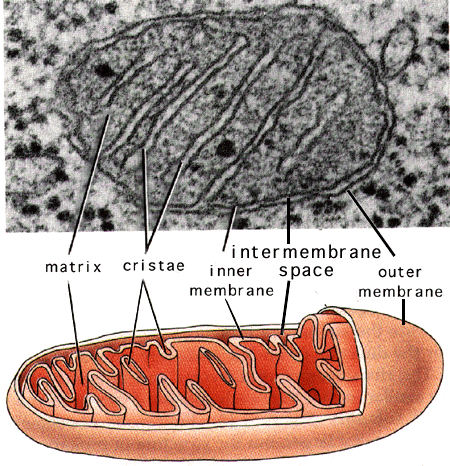
So, with just these three lipids, we can bend a lipid monolayer in either direction. If they were arranged around something, they could even form a textured, or curvy, surface. Mitochondria, the powerhouses of the cell, need a large membrane inside as this is the surface required for many of their chemical reactions to take place. This inner membrane requires the presence of all three of these types of lipid in order to bend into flaps to give itself this large surface area (Figure 3). This, however, is not the full story. Although further work has been done, exactly how the membrane changes and its dynamic nature through processes such as cell division are not yet fully understood.     


Figure 3. Curvature in membranes in the mitochondrion; , shown in both an electron micrograph, and a drawn diagram. Image from Brooklyn College City University of New York


Notes

* In in a cellular system, bending towards the water is known conventionally as negative curvature.

 A Long Name, a Long Lipid: Docosahexaenoic Acid Friday, Dec 2 2011 

It is often difficult to get a handle on what molecules are and what they do. In biological systems, there are many that carry out and are involved in several unrelated processes, as we have seen with cholesterol. This means the work that scientists need to do to uncover a molecule’s true importance usually requires contributions from several scientific disciplines. However, cholesterol does not quite fall into the category of the molecule I want to discuss here, because unlike cholesterol, we cannot make all that we need of this molecule. It is a fatty acid called docosahexaenoic acid.

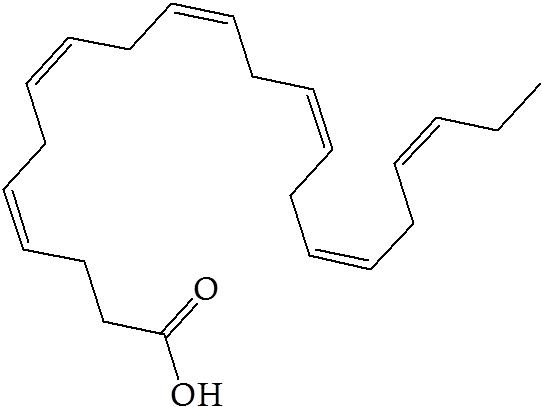
Fear not if its name looks incomprehensible, it is a name invented by organic chemists to state unambiguously what the molecule is and how it is built atomically.  The name is often shortened to DHA, which I think you will agree is more manageable.  It is given the trivial name cevronic acid. Whatever we choose to call it, there is evidence that without it, several of our bodily systems would suffer.  Its presence in the nervous system is well documented [1].  The amount of DHA in a neurone’s membrane influences the action of proteins that control whether potassium, sodium and calcium ions are inside or outside of a cell.  These are proteins are known as ion channels, and although what they do might sound a bit trivial, their behaviour is particularly important for all nerves. The impulses involved in walking, talking and touching, all rely upon ion channels in order to get from or to the brain, along sensory or motor nerves.  And this is just DHA in its ordinary form, as shown in Figure 1.  DHA is also found in our eyes, in the retina in fact, and helps us to see things properly: it helps turn the light that falls on our eyes into the nerve impulses that go to the brain. So the fact that you are reading this is thanks, in part, to DHA.


Figure 1. Docosahexaenoic acid (DHA), also known as cevronic acid.


DHA also has a measurable effect on the lipids it is used to make. The best published example to date is also concerned with vision. DHA can be used to make phosphatidylcholine [2], whose name is also shortened, this time to PC. It is found in the membranes of cells in the eye and its job is a physical one. The PC that contains DHA makes the membranes more ‘fluid’. This is the opposite of the effect of the presence of cholesterol [link], that stiffens the membranes. The simple advantage of a more fluid membrane is that the proteins in it, such as ion channels, do not get squashed. Biophysicists describe this in terms of membrane pressure, and it is pretty easy to understand.  Imagine you are holding hands with the love of your life. It is nice to know that s/he is there, but if the grip is too little, it is not really happening, and if it is too much, it hurts.  This is rather true with a membrane: if it is too fluid, the membrane cannot resist changes in the environment and is open to the risk of falling apart.  If the membrane is too stiff, the proteins are under pressure and cannot work properly. DHA is one of the molecules that contributes to this balance.  In terms of your vision, it allows the plasma membrane of the cells at the back of your eye to be fluid enough for the proteins, called rhodopsins, to do their stuff. 

But humans have a problem; we cannot make this fatty acid.  It is nothing to panic about as we can get much of what we need from easily available sources – fresh fish being the richest natural one.  An even better one in terms of mass, is popping a cod liver oil tablet, packets of which can be bought from just about every vaguely food shop or pharmacy in the country.  The larger supermarkets have their own brands of it; it is not a difficult product to put together and sell.  In the shops it is often placed alongside vitamin and mineral supplements.  However, as it is a dietary supplement it is subject to much of the same sort of scientific and media attention as vitamin pills.  Recent evidence indicates that too much of certain vitamin and mineral goodies in our diet, can be counter-productive.  So, if you find your joints are less flexible than they once were, or your eyesight is worsening, DHA might give you a bit of a hand. However, unlike vitamin and mineral supplements, it will not shorten your life just like that.  As you are consuming a fatty acid, if you eat too much, you will put on weight instead.

References

[1] N. Salem, B. Litman, H. Y. Kim K. Gawrisch, Lipids, , 36, 945-959. http://www.springerlink.com/content/r2326m7553u64258/.
[2] B. J. Litman, S. L. Niu, A. Polozova, D. C. Mitchell, Journal of Molecular Neuroscience, 2001, 16, 237-242. http://web.pdx.edu/~drakem/papers/J_mol_neuro-2001.pdf