Dr Samuel Furse » 2011 » November

 What Do Membranes Do? Thursday, Nov 24 2011 


We know that membranes in cells are complicated, and we have a pretty good idea of what they look like (Figure 1). We also know that the plasma membrane, the membrane that is the edge of the cell, is the thing that makes the cell a cell. At the very least, it means the cell is a discrete entity, and not just a loose collection of cell parts in one place. This might seem a serious job on its own, and it is, but there is more.
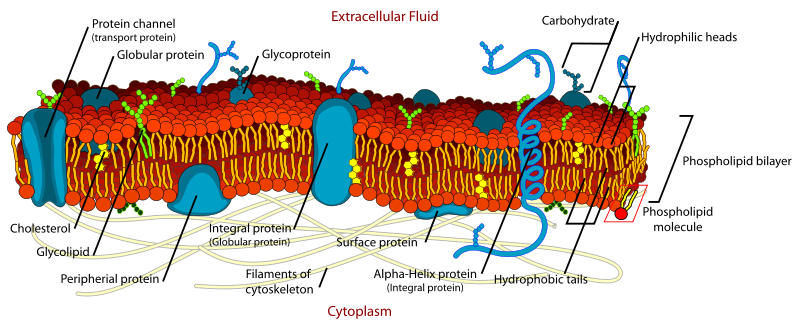

Figure 1. Schematic representation of a cell’s plasma membrane, showing the lipids along with peripheral and integral proteins, glycoproteins, surface proteins, ion channels, and carbohydrates. Note also the cytoskeleton filaments that, together with the plasma membrane of the cell, give it a life-supporting structure. Picture courtesy of WikimediaCommons.
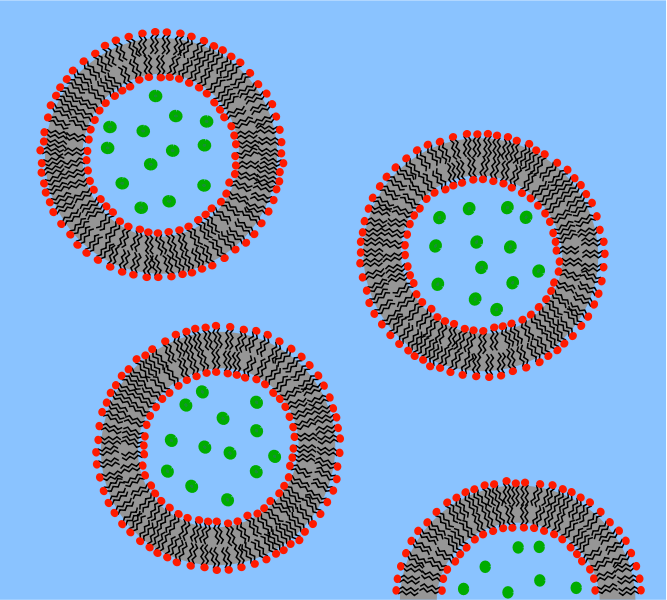
Figure 2. Schematic representation of vesicles, with lipids forming a bilayer around a small body of water with other solutes (green blobs). Picture courtesy of WikimediaCommons.

Bilayers, such as that shown in Figure 1 contain various types of protein and some bits of carbohydrate*. However, to do the job of separating the cell’s insides from its environment, none of these other components are necessary. It is perfectly possible to create a sturdy bilayer from lipids alone. When this bilayer is formed in flat sheets and stacked up four-by-two, it is known as a lamellar phase [1], and when a bilayer is shaped like a ‘bubble’, it is known as a vesicle (Figure 2) [2].  Vesicles may sound a curiosity, but they are very useful in research laboratories. They provide a sort of stepping-stone to understanding complete cells as they can be of a similar size, but are much less complicated biochemically. So, if a scientist wants to test an idea or hypothesis without the complications of a testing it on a whole cell, a vesicular system is a useful one to try it on first. If the job of being a skin, a border between the inside of the cell and the outside, can be done so simply by a lipid bilayer, why does the cell go to the trouble of having the rest of the gubbins there?

The question becomes more pressing when we consider that there are a variety of proteins in the membranes of cells of both animals and plants. Not only that but, proteins are oten more complicated to make than lipids. The question has been raised not only about cells, but also about the parts of a cell that have a membrane or mono-layer covering of lipids. These parts of a cell are known as organelles.

Murphy and Cummins [3] asked this question directly about the organelles that store oil in seeds like Brassica Napa (rape seed). It is an interesting question, and there is an understood answer.   Consider this: if you were to put together an organisation of people in order to produce, say, a new range of chocolates, you would undoubtedly want several types of person. You would want people who could physically make the chocolate itself, so that you had chocolate to sell; you would want people who could design the chocolates, so the product had a chance of being consistent, coherent and tasting good; you would want managers to over-see the work of both of these teams; you would want market analysts, a legal team, HR and so on. Many types of people, probably too tedious to name individually. But you would need something else, too. You would want them to be able to talk to one another. You, as the philanthropist of your very own chocolate–making enterprise, would need them to communicate so the company’s activity is co-ordinated and coherent. With cells, it is just the same: the various organelles need to be able to communicate with one another in order that the cell can stay alive.   In order for a cell to stay alive, it must do a multitude of things – take in food, get rid of waste, resist changes in the environment, grow and replicate, to name but a few. And of course all of this must be co-ordinated so the cell does not die. An important part of this is cellular signalling.

As you might imagine, in order to perform a complicated set of processes, cellular signalling takes on a variety of forms – just like the large vocabulary required for a whole company to communicate with itself effectively. The complexity of cellular signalling has been made clear in recent decades, and now there are at least four scientific journals that focus on this aspect of biology alone, namely Cellular Signalling, the Journal of Cell Communication and Signalling, the Journal of Molecular Signalling, and Cell Signalling Biology.   The role of lipids in cellular signalling is a wide topic, and will be examined in other entries in this blog. Examples include how insulin lowers blood sugar level, and how the cytoskeleton (Figure 1), and thus the shape of the cell, is managed.


References and Notes

*Anything with the prefix ‘glyco-’ either is a carbohydrate or has one attached to it.

[1] F. D. Gunstone, John L. Harwood, Fred B. Padley, The Lipid Handbook, 2nd Ed, 1994, ISBN-13: 978-0412433207.

[2] J. C. Stachowiak, D. L. Richmond, T. H. Li, F. Brochard-Wyart, D. A. Fletcher, Lab on a Chip, 2009, 9, 2003–2009.

[3] D. J. Murphy, I. Cummins, Phytochemistry, 1989, 28, 2063-2069. http://www.sciencedirect.com/science/article/pii/S0031942200979214
 Cholesterol: A Two-Faced Dark Horse? Saturday, Nov 19 2011 

Cholesterol causes death.  At least that is what some people seem to suggest.  Or at least if you are a man, apparently it will.  There are other examples where it seems to be implicated rather clearly in an alarming context.  However, it is equally touted as being instrumental in amazing cures.  This rather up-and-down feel to the tabloid portrayal of cholesterol is somewhat at odds with the careful marketing of certain pseudo-dairy products that are “proven to reduce cholesterol”.  This latter phrase and related ones imply, of course, that cholesterol is a bad thing.  

 It is well known that we can have too much of a good thing, especially in our diet.  Cholesterol does not quite fall into this category as just about every cell in our body can make all the cholesterol it needs [1].  As it is not a waste product, this suggests to me that it is not overtly harmful: it is obviously important that our bodies have it, otherwise they would not make it. So why is it there?  There is a lot of physical evidence that suggests that cholesterol makes up as much as a quarter of the mass of the plasma membranes of several types of human cell [2].  For other cell types, it is less, and for E. Coli bacteria, it is none at all [2].  This presence in cells is partly due to what can be made from cholesterol.  It can be made into vitamin D, known as calcipherol (usually written calciferol), a process that famously uses sunlight.  It is also the starting material for the body’s production of steroid hormones, the better-known ones being testosterone and the oestrogens.  I think these points sound like strong enough reasons for cholesterol to be sloshing around inside us, but there is more. 

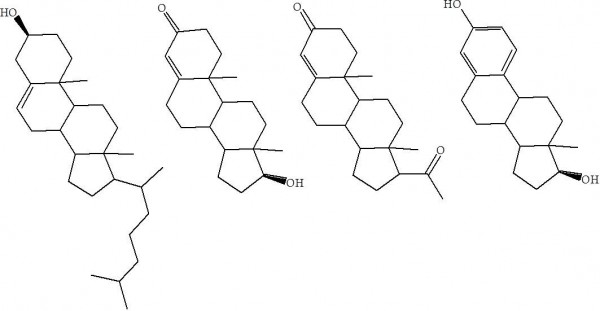
Figure 1.  From left, structures of cholesterol, testosterone, progesterone and oestradiol. The latter is one of the three hormones that make up the group of oestrogens.

The utility of cholesterol is not confined to vitamins, sex and puberty.  The structure of cholesterol (Figure 1) shows very little functionality that can interact with water, suggesting that it is more lipophilic than hydrophilic.  If it cannot dissolve in water, thermodynamic favourability would suggest it is found in fattier parts of the cell.  This is indeed the case, with as much as a quarter of the plasma membrane’s mass being cholesterol, it seems reasonable that it must have a physical impact on the properties of the membrane, implying that it must have some purpose.  This has indeed been researched, and the results suggest that the presence of cholesterol stiffens the membranes [3].  This is described as a change in the membrane’s fluidity [4], with higher cholesterol giving rise to greater stiffness.  Thus cholesterol is part of the system that gives a cell its shape.  If you are thinking that most cells are rather shapeless blobs, consider for a moment how different the shape of a sperm cell is to a red blood cell, or an ovum.  For some, their shape is very precisely controlled.  

The stiffening of the plasma membrane has further ramifications for diffusion across the membrane.  Sodium ions, potassium ions and water diffuse more easily across more fluid membranes.  Thus the presence of cholesterol influences the speed of diffusion of these particles.  These are important things that the cell must keep a check on in order to survive. It is perhaps particularly surprising to note that cholesterol is able to achieve all of these things without being a lipid – it is not amphiphilic.  However as it is so closely associated with lipids and lipid systems, it is usually given a place in databases on the subject, as well as in journals on the physical chemistry of lipids.  

The fact that cholesterol has its fingers in many bodily pies does rather beg the question of what happens when cholesterol is too high.  Physically of course, we can imagine that the membrane will be stiffer than is optimum, reducing the cell’s ability to change shape without being damaged, and with compromised diffusion across the membrane.  But what else?  The easy answer is what is known as furring of the arteries, so called due to the appearance of the inside wall of the arteries under such circumstances.  In reality, no fur has formed.  What has happened is in fact physical and is related to the hydrophobic effect.  Cholesterol, not being able to dissolve in water, concentrates here along with calcium salts.  The latter is a well understood and unrelated phenomenon that is age-related.  The suggestion arising from concentration of cholesterol in arteries is, naturally, that too high a level of cholesterol means that there is more to deposit.  

This gives a rather nasty sting in the tail for a molecule that is otherwise rather essential for us to be what we are; in fact no vertebrate would be able to reach adulthood without its derivatives.  What this story serves to highlight is the double-edged nature of many of the lipid-related biological molecules: not only can we have too much of a good thing, but too much of an essential one as well.

References

[1] F. Xu, S. D. Rychnovsky, J. D. Belani, H. H. Hobbs, J. C. Cohen, and R. B. Rawson, Proc. Natl. Acad. Sci. USA 2005, 102, 14551-14556.  http://www.pnas.org/content/102/41/14551.full

[2] P. L. Yeagle, Biochim. et Biophys. Acta, 1985, 822, 267-287.  http://www.sciencedirect.com/science/article/pii/0304415785900115

[3] K. E. Bloch CRC Crit. Rev. Biochem., 1983, 14,47-92.  http://informahealthcare.com/doi/pdfplus/10.3109/10409238309102790

[4] J. A. Clarke, A. J. Heron, J. M. Seddon, R. V. Law Biophys. J., 2006, 90, 2383-2393.  http://www.sciencedirect.com/science/article/pii/S0006349506724213

 “Bubbles, Bubbles, Everywhere, But Not a Drop to Drink” Friday, Nov 11 2011 


Soap is something we all use every day, without even really thinking about it.  Well, most of us use it every day.  But how much do you think about it?  Do you feel you know what it does or how it works?  Do you even need to know either of these things?

Of course it is perfectly possible to live a full and active life without knowing anything about soap at all.  Most people get as far as which one(s) they like the smell of, and possibly which ones their skin does and does not react well to.  What might help with the latter, as well as the behind-the-label study of these products, would be some understanding of the terminology used on these toiletries.  For example, Pears® now market something for washing hands that is “100% Soap-free”.  Bayliss and Harding market a “cleansing hand wash”, that is not soap free. 

In order to understand the difference between these two, and believe me they both wash your hands perfectly well, we need to know what soap is, and what it does. It may seem trivial, but I would also suggest we need to know what its purpose is as well, so the stuff we rub all over ourselves in the bath does what we want it to.

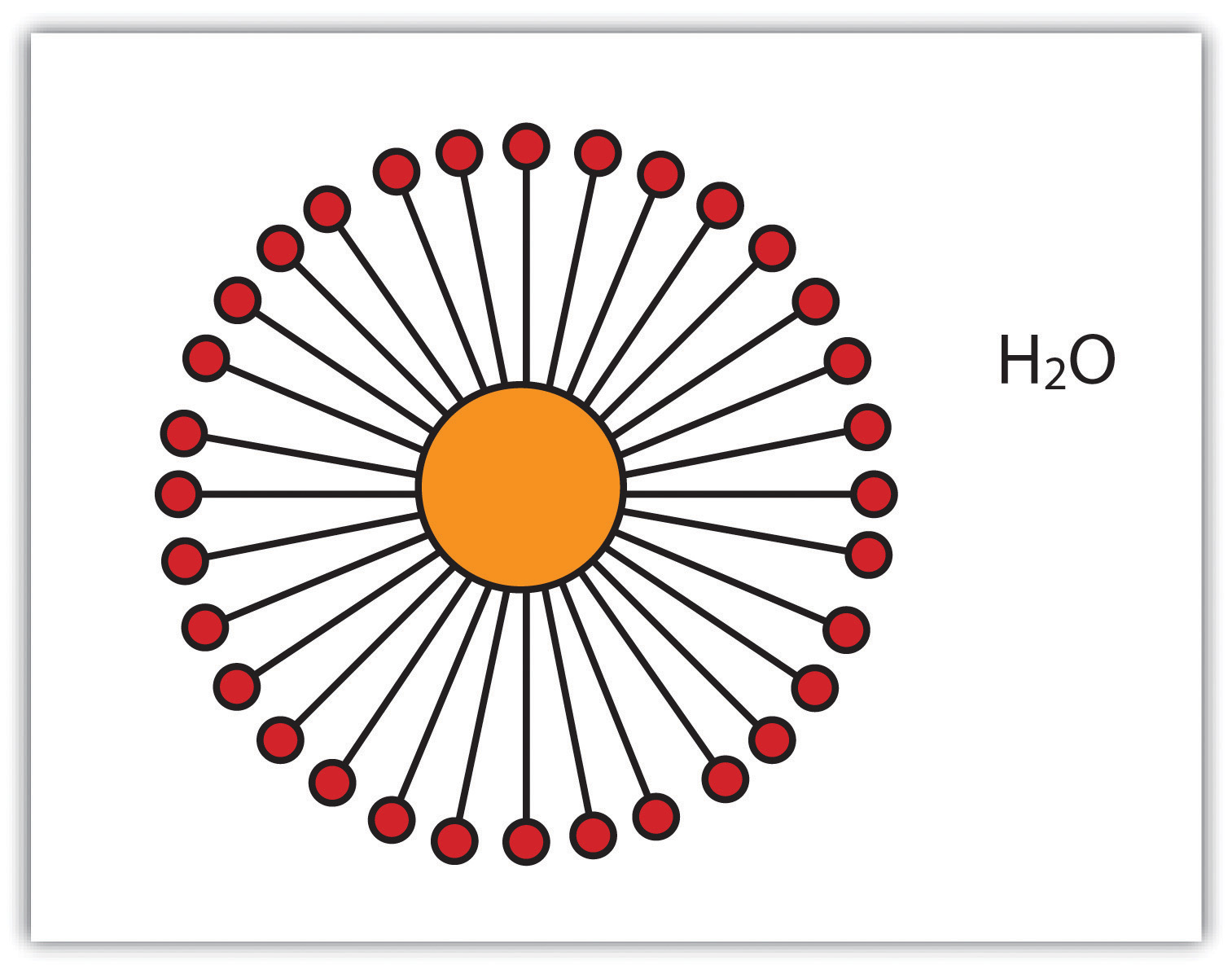
Figure 1. A cross-section of a micelle of the type formed by surfactants. The orange region (middle) is the grease around which the surfactant molecules are packed. Photo copyright: www.flatworldknowledge.com.

The obvious job for soap is to clean us, our clothes, our house/office etc., one way or another.  What it is doing of course is removing grease and dirt.  It does this by making the grease and dirt soluble in water.  If you are thinking either that something like a lipid could perform this task, or, that such a mixture of grease and water is an emulsion, you are absolutely right.  Tragically, although lipids are good at dissolving grease, they are often hard to wash away completely with just water.  So we need something slightly different for this job.  We need something that is more like a surfactant. As it happens surfactants and lipids are quite similar.  They both have sections that like water (hydrophilic), and sections that like grease (lipophilic).  However, the self-assembly properties of surfactants are slightly different to those of lipids. Typically, lipids form bilayers or cylinders, where surfactants form micelles (Figure 1).  Micelles are particularly good at trapping grease as the surfactant molecules can fit around the grease droplets, with their water-liking head groups facing out. This allows the grease to dissolve in the water and therefore be washed away.
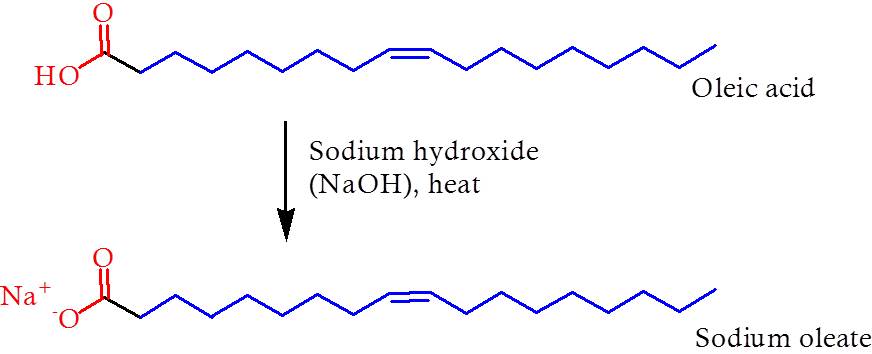
 So we know what these sorts of molecules are doing physically. But what is soap?  Well, like lipids and surfactants, in order to dissolve grease into water and form an emulsion, it needs aspects of both water and grease to be an effective emulsifier. Soap is in fact made from fat, known to scientists as fatty acids. The fat is boiled up with some caustic soda (sodium hydroxide), and so we have made a sodium salt from the fatty acid (Figure 2). This is more or less how soap has been made at least as far back as Tudor England. The source of fat in that case was mutton, and the hydroxide was cobbled together from heating mens’ urine. These days, sodium hydroxide is commercially available, and a variety of sources of the fat are used – everything from whale blubber to olive oil.

Figure 2. The preparation of soap from a fatty acid, using sodium hydroxide. This is essentially the same chemical process that has been used to make soap since Tudor times, and is also how it is apparently made in the film Fight Club. In the film, the main character uses fat from liposuction patients to make cakes of soap that he then sells to reputable shops.


So that is not only the physics but chemistry of soap covered. One last thing you may like to know: how can we have soap-less soap? Well, ‘hand wash’. Lateral thinking would suggest that we need a surfactant that is not made from a fatty acid. And that is more-or-less what we use. The most common one is usually called sodium lauryl sulphate on packaging, though there are a couple of different names that are similar to that one. It is commonly used in shampoo. Scientists call it sodium dodecyl sulphate and it has many uses. For example, is used by molecular biologists to separate proteins according to their size. Think of that next time you are washing your hair.  


 The Structure of a Membrane Saturday, Nov 5 2011 


Every cell has a membrane.  The membrane is often described in simple terms as being like the ‘skin’ of a cell.  Without the membrane, the cell would die, in a similar way that if a person lost their skin, they would die.  However, this does not tell us much about what the membrane is or how it is constructed.  

We know from the structure of lipids that they are amphiphilic.  This means that part of the lipid likes greasy substances and part of it likes water.  This bi-polar structure is at the heart of the behaviour of lipids and can be observed when they are exposed to water.  When lipids are put into water, the lipid molecules re-arrange so that the water-liking section faces the water, and the greasy-section is shielded from the water (known as self-assembly).  This is behaviour is driven by the hydrophobic effect.  The hydrophobic effect is an important one in the construction of biological membranes.  The presence of water means that the lipids assemble themselves into a bi-layer.  This bi-layer* contains two ‘sheets’ of lipids (called mono-layers) in which the head groups (water-liking sections) face towards the water, and the greasy sections (tail regions) face away from the water and towards one another, Figure 1.   This satisfies the hydrophobic effect because the greasy sections are shielded from the water, where the water-liking sections are allowed to interact with it.  Biophysicists describe this in terms of energy: it is energetically favourable for the water-liking parts of the molecule to interact with the water, and energetically favourable for the greasy parts not to interact.  


Figure 1. Left: The assembly of lipids when exposed to water (marbled blue region). The plain blue areas are the water-liking regions of the lipid molecules (head groups), with the red sections showing the greasy sections (tail groups). Right: These regions are shown in an example lipid, phosphatidylcholine. Figure 2) and was proposed in the journal Science in 1972 [1].  This model is based on the idea that the membrane is flexible and molecules can move sideways in the mono-layers, allowing different parts of the membrane to do different things.  

Figure 2. Fluid Mosaic Model proposed by Singer and Nicholson. Diagram from Alberts et al. [2].

However, recent evidence suggests that the Fluid Mosaic Model is a bit simplistic.  Certain important processes in a cell’s life cycle are not well explained by it.  This includes cell division, in which the membrane must also be divided.  There is also evidence that the cell’s internal signalling processes use the membrane.  Another aspect that must be taken account of is that the membrane does not exist independently of the rest of the cell. It does not just sit there.  The membrane is shaped by something called the cyto-skeleton. This is a network of tubes made of protein that appears in all types of cell, and like our own skeletons is far from inert and unchanging.    

So, the poor old Fluid Mosaic Model has been superseded. Even it was not fluid enough to keep up with newer understanding.  Although the more recent research has allowed us to see how crucial the membrane is in the running of the cell, it left biologists with a problem.  How do we advance our knowledge of the membrane?  Several approaches have been taken.  One of these is to look at the physical behaviour of membrane constituents to find out what their contribution to the system is. This data is then used to build up a picture of the relationships between the different molecular components.  This approach is called reductionism and is related to the method used by Leland Hartwell, Tim Hunt and Paul Nurse and others in discovering the role of certain proteins in the control of the cell cycle.  It has been used to inform our understanding of the physical role of structural proteins (e.g., the BAR domain [3]) as well as lipids such as phosphatidylinositol [4], and cholesterol [5].    

The evidence that a reductionist’s approach has started to bear fruit is that ‘synthetic cells’ [6] have been made.  The fact that it is possible to prepare such entities, albeit basic ones compared with many if not all cells in nature, suggests that the accumulating understanding of the components of cells is broadly representative of the systems found in nature.   

References

*this word is frequently unhyphenated.

[1] S. J. Singer, G. L. Nicholson, The Fluid Mosaic Model of the Structure of Cell Membranes, Science, 1972, 175, 720-731.  http://www.sciencemag.org/content/175/4023/720.abstract?sid=5f637971-587b-43b6-b304-14a62e7f9114.

[2] B. Alberts, D. Bray, J. Lewis, M. Raff, K. Roberts, J. D. Watson. Molecular Biology of the Cell; 3rd ed., Freeman, 1994.

[3] W. M. Henne, H. M. Kent, M. G. J. Ford, B. G. Hegde, O. Daumke, P. J. G. Butler, R. Mittal, R. Langen, P. R. Evans, H. T. McMahon, Structure, 2007, 15, 839-852. See also Pykäläinen et al. Nature Structural & Molecular Biology, 2011, 18, 902–907, and Dawson et al., Trends in Cell Biology, 2006, 16, 493-498.

[4] X. Mulet, R. H. Templer, R. Woscholski and O. Ces, Langmuir, 2008, 24, 8443–8447. http://pubs.acs.org/doi/full/10.1021/la801114n.

[5] D. A. Brown, E. London, The Journal of Biological Chemistry, 2000, 275, 17221-17224. http://www.jbc.org/content/275/23/17221.full.

[6] T. F. Zhu, J. W. Szostak, Journal of the American Chemical Society, 2009, 131, 5705-5713. http://pubs.acs.org/doi/full/10.1021/ja900919c.