Dr Samuel Furse » 2012 » February

 Fat is a Biological Issue Saturday, Feb 18 2012 

One of the first things we may notice when we meet someone new is whether they are fat or thin.  Equally, one of the first things we notice about people we know, but may not have seen for some time, is whether they have gained, or lost, weight.  The fact that the mass of adipose tissue can differ within an individual, and indeed fluctuate in their lifetime, is perhaps a clue to how our bodies store fats.

It is correctly well known that fats are a biological energy store.  In mammals, fats are stored in cells called adipocytes.  It is a useful adaptation to be able to store energy for use later, as it means that meals can be further apart and larger, if necessary.  Some species are much better at this than us, as demonstrated recently on a BBC documentary by Prof Richard Fortey.  Some species of turtle, and crocodiles, can survive for well over six months without a meal.  Indeed, this is an important factor in how their species survived a mass extinction event 65 million years ago in which their previous sources of food were compromised.  The ability of such cold-blooded creatures to reduce their calorific expenditure, by lowering their body temperature, is also a factor.  Although warm-blooded mammals such as humans would be hard-pushed to survive such an event if it happened today, we have at least adapted such that typically, missing a meal or even two, does not result in death due to starvation.

These observations beg questions about how fat is stored in our bodies, how it is stored in the bodies of metabolically efficient reptiles like crocodiles, and how our bodies release these stores of energy.  It would be no good if the stored energy were unavailable at the crucial moment.  Equally when the energy is released, it needs to be the right amount such that the individual can do what it needs to, without wasting those stores.

Mammals differ from plants in how fat is stored: in mammals there is one large fat droplet per adipocyte, whereas plants tend to use several, smaller stores. Adipocytes can be up to 120 µm wide, roughly 15 times wider than a sperm cell (8 µm) [1].  This enables them to store large amounts of fat in each cell.  This is part of the reason why, under normal circumstances, the number of adipocytes in a person does not change.  What changes if they gain or lose weight is the size of the fat store in each cell. The operation that removes some of the fat cells is called liposuction.

The vehicle for this storage of energy is the triglyceride (Figure 1).  Interestingly, this is exactly the same molecule used by plants for the storage of fat, and is the principal constituent of olive oil.  Triglycerides are moved around our bodies by assemblies called lipoproteins.  This means that when muscular tissue requires energy from fat stores, it can call upon that stored in adipose tissue, similar to the way that you can order your food shopping on-line and have it delivered to your house.

Once the fat arrives at the cells that will metabolise it, such as muscle or liver cells, the lipoproteins are taken up by the cells and place the fat in small reserves in the cell [2].  These are not convenient for long-term storage in muscle cells in particular, and so the vesicle that contains the lipoprotein is soon joined by another organelle called a lysosome.  This organelle provides the enzymes required for metabolising the proteins delivered, while the triglycerides are given over to mitochondria.  Mitochondria are responsible for turning the fat into energy and it is thus not for nothing that they are known as the power-houses of the cell.
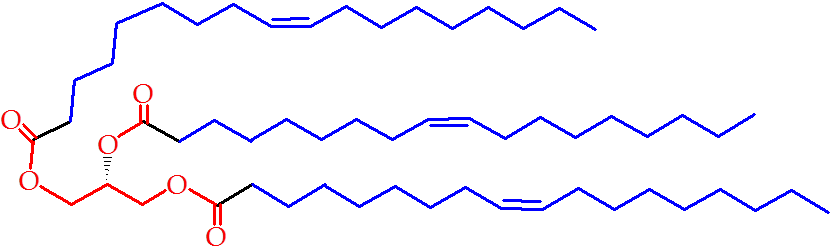
Figure 1. Triglyceride, a molecule composed of three fatty acid molecules and one glycerol moiety. The blue sections represent the lipophilic part of this pseudo-lipid, where the red section is the most polar part of it. However, this polarity is insufficient to confer self-assembly properties on the molecule and thus it is a fat, rather than a lipid.

The chemical process goes by the unlikely-sounding Citric Acid Cycle (CAC), the discovery of which won Sir Hans Krebs a Nobel Prize in 1953.

You may be wondering where the atoms that made up the fats go.  Needless to say they are not destroyed by our bodies, so they must be dealt with somehow.  Figure 1 shows that fats are made up of carbon, hydrogen and a little bit of oxygen.  The hydrogen binds to oxygen, forming water that can either be lost in urine, or more usually, as water vapour in our breath*.  This is only part of the reason that heavier breathing is typical during physical exertion; the carbon from fats is turned into carbon dioxide that is also lost when we breathe out.

One last point about fats is that, like cholesterol, we can make as much of it as we need to.  Thus the nutritional requirement for fat is virtually nought, though they do have an impact on our enjoyment of a meal.  This adaptation indicates to biologists that a varied and not necessarily regular dietary intake was a significant factor at some point in human evolution: we have adapted to enjoy eating fats but can make all we need.

References and Further Reading

[1] B. Alberts, A. Johnson, J. Lewis, M. Raff, K. Roberts, P. Walter, Molecular Biology of the Cell, Garland publishing, 3rd edition, 0815316208.

[2] D. Voet, J. G. Voet, C. W. Pratt, Fundamentals of Biochemistry, John Wiley, 0471586201.

*We lose around 0•1 mL of water each time we breathe out. Based on breathing out once every 3 seconds, this means we breathe out just under 3 L of water each day.  Three or four urinations per day, of around 200 mL each, give rise to the loss of less than 1 L of water/day.
 

 When Plants Get Hormonal: Jasmonic Acid Thursday, Feb 9 2012 

Lipid synthesis is not always an end in itself.  While lipids and fatty acids are undoubtedly useful in themselves – for the formation of biological membranes and as signalling molecules in biological systems – they can also be a raw material for other processes. One such process is the preparation of the hormone jasmonic acid in higher* plants [1].

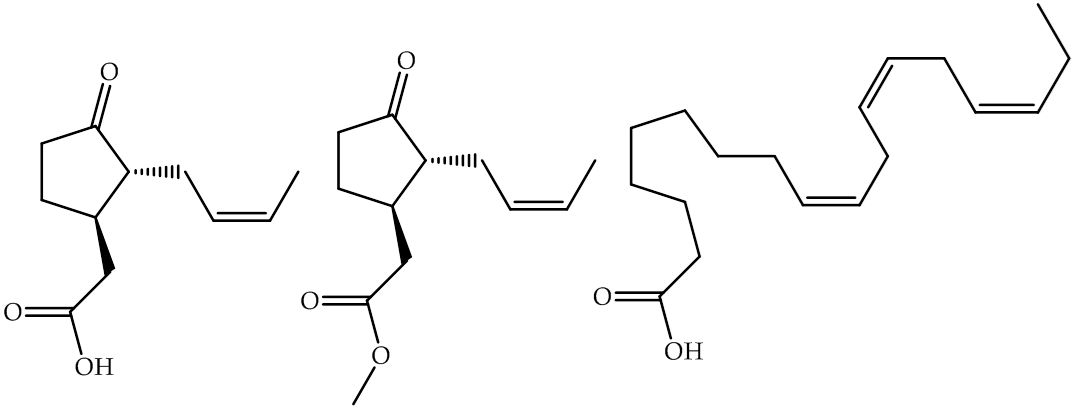
Plants are often not thought of as hormonal organisms and, while this is true for the simplest plants, more sophisticated plant species are reliant on a number of processes for survival, including growth in relation to sunlight and temperature and reproduction.  These processes can all be induced and controlled by the release of hormonal chemicals.  Jasmonic acid, like cholesterol-derived testosterone in mammals, typically has a range of effects on the plant. Under normal circumstances, it forms part of the development of the plant, including flowering and the formation of fruit.  Under stress, i.e., during a drought or after an injury, this hormone is part of the system that allows the plant to repair itself. But even that is not all.  Jasmonic acid is volatile (will evaporate easily), as is its methyl ester derivative (Figure 1).  The latter form, also found in plants and with similar activity to the acid, is also valuable in the perfume industry [2].

With such a variety of uses in higher plants (some of which are as important and quick as self-repair) speedy preparation of this hormone is required.  It is perhaps therefore not surprising that the raw material used to make this hormone is plentiful.  Plants use a fatty acid, called α-linolenic acid, to make jasmonic acid and its ester derivative (Figure 1) with the first stage of this process being the removal of the fatty acid from the membrane.  This starts with an enzyme called lipase that cuts up lipids.  In order for the hormone’s structure to be formed, oxidation is required to install a ketone and shortens the carbon chain from 18 carbons, to 10.  As you might imagine, these processes require several steps and thus several enzymes.

Figure 1. Jasmonic acid (left) and methyl jasmonate (middle), the methyl ester of jasmonic acid. The raw material for biological preparation of this hormone, α-linolenic acid (right).

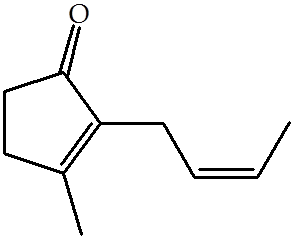
The fact that several steps are required is perhaps more useful than it may sound, not least to the process of evolution.  It gives the opportunity for a huge range of mutations, and thus a huge range of changes and tunings of the system.  Not only does it mean that there is scope for variations of these two signalling molecules, but also the receptors with which they react can be more or less sensitive.  Perhaps not surprisingly, this has given rise to several related hormonal derivatives, such as jasmone [3].  This has led to an understanding of a variety of effects in plants, and lends growers a measure of control over the plants they cultivate.However, perhaps more elegant of all is the jump from the plant kingdom to the animal one.  The relationship between plants and insects is well established, with several insect species playing a crucial role in pollination.  Yet, in the case of a jasmonic acid derivative, it is the insects’ reproduction that is altered.  The hormone jasmone (Figure 2) is produced by the insect, a weevil called Bruchus pisorum, but can be detected by the plant, a member of the pea family, in breathtakingly low concentrations.  The plant is able to detect the hormone in what is known as the femto-molar range [4].  This means a limit of detection of 0•00000000000015 g of the hormone in 1 L of water.  To put it another way, the plant can detect this hormone, and thus the presence of the insect, at a level at which 1 Kg of jasmone is dissolved in a volume of water twenty times that of the Indian Ocean.

Figure 2. The structure of jasmone, a hormone that can be detected by members of the pea family at very low concentrations.

The effect of this hormone is to induce cell division and a strengthening of the plant’s its fibrous tissue.  This is something of a problem for the insect, as it means the larvae find it much more difficult to bite their way out of the plant’s tissue when they are fully grown [3].  So only the adult insects that produce both the larvae with the best eating action, and that emit the lowest amount of jasmone, are likely to survive.  However if the plant has no defence against this invading insect, it too will die out and the insect species will follow shortly after.  What is perhaps most exciting is that this indicates that the plant’s sensitivity to jasmone is helping to shape genetic changes in the insect population, and vice versa.  Needless to say, the struggle is not over – it never is with evolution – but it remains to be seen what will happen in the next stage of the relationship between the predator and the prey with respect to this lipid-derived hormone.


References

*This is the name given to plants that have a more complicated structure, including sexed plants (angiosperms), and so applies to trees and flowering plants, but not algae.

[1] R. A. Creelman, J. E. Mullet, Proc. Natl. Acad. Sci., 1995, 92, 4114-4119.
[2] M. Hamberg, H. W. Gardner, Biochem. Biophys. Acta, 1992, 1165, 1–18.
[3] H. Weber, Trends Plant Sci., 2002, 7, 217–224.
[4] R. P. Doss, J. E. Oliver, W. M. Proebsting, S. W. Potter, S. R. Kuy, S. L. Clement, R. T. Williamson, J. R. Carney, E. D. DeVilbiss, Proc. Natl. Acad. Sci., 2000, 9, 6218-6223. http://www.pnas.org/content/97/11/6218.short

 Lipids – Where Do I Go? Thursday, Feb 2 2012 

Research is a notoriously vague occupation. It has more in common with gathering than hunting, and so inevitably has as much support as opposition. Researchers of all types will probably tell you that there is no substitute for putting the hours in and, of course, knowing where and how to look. These skills are undoubtedly useful when wanting to find more information on a subject as wide as lipids. In researching something in the 21st Century, our first port of call is typically Google, or, when in dire straits, an on-line encyclopaedia that is best left unnamed. As a source of information on lipids I cannot speak highly enough of this blog of course, but even it cannot contain everything. So, what if you need to go further?

There is a huge wealth of what is known as primary literature. These are original research papers that have been published in peer-reviewed journals*. What this means is that a scientist, or more usually a group of scientists, has written up some experimental work typically in a format of several sides of A4 long. This is submitted to a scientific journal, who send it to anonymous reviewers, who then send back comments. Assuming that the reviewers are not out of their depth, and the authors are professional about the process, the manuscript will be modified by the authors and resubmitted. If it is then thought suitable, it is accepted for publication. A large number of articles are accepted every month, these are published in sets (issues). As one may imagine issues are bound together to make up volumes.

The wealth of information in the primary literature is undoubtedly a hugely important one. It is often not necessarily difficult to find journals that are focussed on lipids; indeed there are a number focussed in this area, but there are some limits to this source of information. Unfortunately, such journals can be difficult to obtain access to if readers are not members of subscribing institutions (Universities etc.). Additionally, finding the right papers can be difficult for non-specialists: it is as easy to get bogged down as it is to miss crucial works. A more readily accessed, and smaller body of work, is the secondary literature.

Secondary literature is the term commonly used to refer to books on a given subject. A quick search on Amazon readily reveals the abundance of lipid literature that is available. Inevitably some titles can be picked up for almost nothing, a nominal £0.01 plus postage, and can allow one to put together a library of sorts on this subject with little effort. Although they are mostly titles resulting from investigative analyses of fat or lipid components of food – trans fats, cholesterol and so on – they provide a source of practical information. Others are perhaps a bit less scientific – for example, some seek to draw a distinction between good and bad fat, and another that appears to purport the belief that lipids form an important part of slowing the ageing process.

There is much in the mid-range but if you are feeling rather rich, educational and scientific books about lipids with much smaller print runs, but much more reliable information, are also available. At current prices, a little over £800 can buy you a copy of Lipid Research Methodology from 1984. Although now probably superseded in all principle tenements, it provides a good historical view of lipid chemistry. A newer book for a mere snip over £900 is The Chemistry of Oils and Fats. If you feel you have more spare money than can be sated by even those, around £1,700 can buy you a treatise on lipid microbiology and for a little more than £3,000 a thorough guide to the mass spectra of lipids is available (!).

You may be comforted to know that few lipid chemists have any such titles, either in the laboratory, or at home. Larger scientific reference libraries may do better, but as the subject of lipids is wide, taking in aspects of biology, chemistry and physics at least, you may prefer to find the right person to ask, instead. And you will be pleased to hear that Google is as good for that as anything else.


*Although non-peer reviewed journals are available, these typically have little value in scientific circles as the work published is not subjected to the rigorous scrutiny afforded by peer-reviewed journals to their issues.