Dr Samuel Furse » 2012 » September

 How Many Parents Does it Take to Change a Lipid? Sunday, Sep 30 2012 

How many parents does it take to change a lipid?  In some cases, it takes “three parents”.  Recent news in the British media has highlighted a debate about ethics in assisted conception.  The Human Fertilisation and Embryology Authority (HFEA) has initiated a consultation about the public response to what has been dubbed “3 parent IVF”.  This debate has been regarded as moot by informed scientists, as the “third parent” in this case provides no human DNA at all, but is a supply of healthy symbiotic organelles called mitochondria.  This procedure is thus equivalent to organ replacement, though it takes place at cellular level. This sort of intervention is well known as a serious undertaking, and begs the question of what sort of problems could require such an intervention. A surprising number are lipid-based.

The lipid basis for mitochondrial disease has far-reaching physical and metabolomic consequences as, unlike most organelles, the correct chemical activity of a mitochondrion relies upon not one but two plasma-type membranes. When we also consider that mitochondria are the organelles that all terrestrial organisms rely upon for releasing chemical energy from glucose, their function is clearly of paramount importance. Thus a fault with one or both of these membranes in the handful of mitochondria in the ovum at conception may give rise to profound effects in the resulting individual.

One such condition is called Barth Syndrome [1]. In this condition it appears that both the fatty acid composition and the amount of cardiolipin are abnormal in the inner mitochondrial membrane. This can deform and even destroy the bi-layer, rendering the mitochondrion useless for its normal function. In practice, this means that muscular function is compromised, especially in cardiac tissue. There are also a number of immunological effects surrounding a low bodily population of neutrophils – the cells used for managing infection. The severity of the symptoms has led to the formation of a number of support groups, such as the Barth Syndrome Foundation*.

Barth syndrome is an X chromosome disorder and is thus more common in males than females, as males possess only one X chromosome. In order for a female to display the condition, her mother would have to be a carrier or display the condition, and her father would also have to display the condition. A mutation of the X chromosome leading to the condition is observable on a molecular level by abnormalities in tafazzin. Tafazzin is an enzyme called an acyltransferase, meaning it is capable of transferring a fatty acid residue from one hydroxyl group to another, including between two individual lipid species. Recent work by Schlame et al. [2], suggests that this enzyme lacks specificity of lipid substrate, but is influenced by the topology of the membrane. This may limit its activity to only very small portions of the membrane (perhaps less than 1%), though in systems where tafazzin is defective, the small areas in which the topology is undesirable for the organelle (and thus the cell) are not corrected. On a general (clinical) level, this means that chemical energy (glucose) is not converted to mechanical energy efficiently. Under normal circumstances, tafazzin helps manage the inner mitochondrial membrane in order that it maintains the correct topology and permeability.

There is also evidence that better-known conditions such as Myalgic Encephalitis (M.E., also known as chronic fatigue syndrome) and type II diabetes may be either directed or mediated by lipid damage or abnormality in mitochondria. Nicholson and Ellithorpe have presented evidence that the dietary application of fresh lipids and anti-oxidants to human patients with Myalgic Encephalitis reduces their symptoms; however it is not clear how these clinical trials were conducted. Perhaps more reliably, a comprehensive body of research now suggests that mitochondrial dysfunction is a factor in the insulin resistance that defines type II diabetes [3]. Notably type II diabetes is associated with older people, and so it is not until other factors that weaken mitochondrial function have had time to take hold, that symptoms associated with insulin resistance are observed. Thus, the occurrence of such conditions in the offspring of child-bearing age adults is not predictable without a comprehensive medical history. The direct female line of the potential offspring is especially important in this as this is the source of the mitochondria.

The fact that mitochondrial disease can be the result of both genetic and dietary problems should alert us to the global significance of this set of conditions. Undoubtedly a variety of approaches is needed to manage the problems involved, but we should be aware that individuals affected by such conditions may be preyed on for the sale of quack ‘cures’, if there are not readily-available and effective treatments that have been soundly tested in a clinical setting.


*This page is not intended as a scientific reference but for public/charitable bodies relevant to this condition.

References

[1] P.G. Barth, H.R. Scholte, J.A. Berden, J.M. Van Der Klei-Van Moorsel, I.E.M. Luyt-Houwen, E.Th. Van’T Veer-Korthof, J.J. Van Der Harten, M.A. Sobotka-Plojhar, Journal of the Neurological Sciences, 1983, 62, 327-355.

[2] M. Schlame, D. Acehan, B. Berno, Y. Xu, S. Valvo, M. Ren, D. L. Stokes, R. M. Epand, Nature Chemical Biology, 2012, 8, 862–869.

[3] J. Kim, Y. Wei and J. R. Sowers, Circulation Research, 2008, 102, 401-414.
 

 Why is he doing this? Tuesday, Sep 18 2012 

I think I am on safe ground when I say that the recent proposals for the replacement of GCSEs, designed and announced and by the Education Secretary Michael Gove, have not been met with unbridled enthusiasm by teachers. There is the inevitable but entertaining vitriol from left-wing commentators like Jeremy Hardy (on BBC radio 4’s News Quiz) and well-written but also left-leaning comments by anonymous writers for national newspapers. The question I really want to ask is whether or not any of us have really thought about this properly.

My approach as a scientist to solving problems is to peel back to first principles and then work forward with a clear idea of what is evidence, understanding and hypothesis, in order to get to a point and which our collective understanding can be increased. I want to apply this to reform of GCSEs, just to see where it takes us. Then, I want you to tell me whether you think it makes sense or whether I have missed anything. I suggest that the first principle in this case is why we have qualifications and exams at all.

My understanding of why we have formal examinations is that with the results of them, we can tell students apart. Some are amazing, some are hopeless and there are a lot in between, and grading is our way of knowing who is which. My understanding of the reason why we have GCSEs is because it is useful for children to learn and understand about the world, and for anyone at or over 16 years of age to be able to show what they have done using an independent nationally-recognised measure in a given academic subject or set of subjects. GCSEs themselves go further, because the subjects taken also indicate what sort of things the pupil in question was best at, languages, English, sciences, etc. We can also tell where the centre of gravity is from the set of grades. A pupil who gets As in a few subjects and Cs in all the rest probably has a clear focus, where a pupil who gets As and A*s in everything is good but not (yet) focussed.

The problem with GCSEs is that they are actually limited in telling pupils apart or being able to show a focus. Grade inflation means that the GCSEs acquired in 2011 do not have the same value as those taken a decade before. This means that a paper given an A in 2011 may not have been given an A in 2001. Other adjustments, such as giving certain pupils more time in exams, extra tutoring etc appear from the outside to be distributed unevenly and/or unfairly. This makes commentators cynical about whether two pupils in the same exam room at the same time, who get the same grade, have the same ability. Another problem is that the testing of the subjects can be unfocussed: why test literacy in a science exam? I would agree that it is good to have literate school-leavers, and it is important to be able make oneself understood in any subject, but I would question whether either of these is achieved by testing the same ability half a dozen times in one set of varied GCSEs. Also, what about the things that the current qualifications have never sought to test? Obvious examples include hard work, tenacity, attitude, memory, consistency and practical problem solving. Surely, a rigorous set of exams should test whether or not a candidate could be arsed?

I would be very interested to know if any of this passed through the mind of the Education secretary in forming his plans for ‘Gove levels’. If it did, the resulting planned reforms seem perverse at the very least. From what I have seen, the only improvement from the understood shortfalls of the current system will be a reorganisation of the examining boards system in order to prevent grade inflation. This is undoubtedly useful as it means that the grade acquired really does mean what it says.

‘Meaning what is says’ is however, another problem with the current system. My evidence for this is from my teacher training a couple of years ago (I did a PGCE in secondary science). As part of this training, we all did a GCSE chemistry paper, a biology one and a physics one, and marked them. The results were surprising. The guy who did a PhD in physics got a lower mark than me in the physics paper even though he could clearly run rings around me where his subject was concerned. The girl who got a better chemistry degree than me and did a PhD in chemistry where mine is in chemical biology, got the same mark as me in the chemistry paper – and, needless to say, she can run rings around me too. This made me and probably the others wonder whether those particular papers really were testing understanding in the relevant subjects properly. We inevitably reached the conclusion that there were flaws in the GCSE system.

I maintain that those flaws should not blind us to the good points. Favouring the rote learning of O-levels because the test of understanding of GCSEs has been discredited by grade inflation appears crass. How good a memory a pupil has is a good thing to test because it is particularly useful for some jobs and some pupils genuinely shine at it. However, it is not useful to test it in 10 out of 12 subjects — and the same goes for the ability to write in essay format. It is useful for potential employers to know how hard-working someone is, both at doctoral level but also for manual work that requires no more intellectual input that the waste paper basket would give.

So, what about a set of exams that could test aspects of someone’s intellectual function as wide as understanding of calculus, the ability to play the difficult bits of Mozart’s Clarinet quintet and whether or not they put their back into something and make steady progress over a sustained period? Would a set of qualifications like that be rigorous, useful to third parties, and most of all, good for a child’s education? I think so. And I think it would be possible to design, implement and administer them without alienating teachers. What do you think?

 A Cellular Problem in Water Purity Sunday, Sep 2 2012 

We need water. It seems not only a basic, but an obvious and easily available thing to pretty much anyone in the first world. It is even listed as a human right by the UN. However, with fresh water being a distinct minority in the global water total, and unevenly spread with respect to human populations, a variety of questions are raised about what may be done to secure the future of water supply and processing. Not least to how toilet design has, and perhaps should, evolve.

And while the apparently uneven distribution of clean water is undramatic for a lot of people, it belies a rather obvious and serious set of questions: one of them concerns processing water, but another concerns testing water to demonstrate whether it is clean at all.

A given body of water may look and smell safe, but how safe it is microbiologically is not necessarily clear. A variety of water-borne diseases blight various parts of the world (cholera, Dengue fever, bilharzia, polio and too many more to mention) and many of these regions do not have suitable facilities for examining water supplies.

This leaves a gap in the market for a method of testing water that is reliable, simple and transportable. One ingenious method, towards which Villalobos et al. [1] have made significant steps in their research, involves the polymerisation of a lipid called TRCDA.

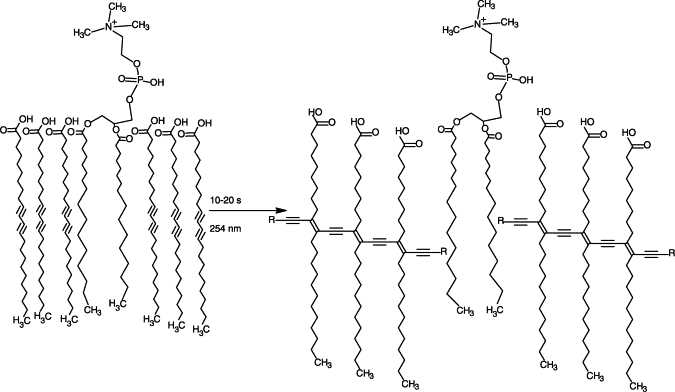
Applying ultra-violet light to water containing TRCDA and live pathogenic species gives rise to a polymerisation reaction between the TRCDA molecules (Figure 1) that in turn results in a colour change from blue to red. The emission of the red colour is proportional to the presence of the number of such species and falls within the visible range so can be observed with the naked eye. It is also possible to make a quantitative measure of the change using a visible light detector similar to that in long-established techniques like immunosuppressant assays and chromophore-detection MS.  The latter is possible because the polymerisation reaction gives a conjugated unsaturated system not dissimilar to that found in red- and orange-coloured vitamins.

Figure 1. When TRCDA (three molecules either side of the phosphorus-containing lipid present) is treated with ultra-violet light for only a few seconds, a polymerisation reaction occurs that gives rise to a clear colour change. The polymerisation reaction gives a conjugated unsaturated system not dissimilar to that found in red- and orange-coloured vitamins. Diagram courtesy of [2].

However, chemical techniques such as this are inevitably sensitive to interference, with issues surrounding the presence of metal cations (calcium, magnesium etc.) that are common in clean drinking water, as well as pH and temperature fluctuation[3,4]. Villalobos et al. have also sought to work around this problem with a more rigorous method development, including the inclusion of a well-established chemical method of removing metal ions, by chelation with an agent called EDTA.

The use of a technique based upon TRCDA also offers scope for investigating the bacterial presence in foods; however the methods have not yet been developed to do so, and significant challenges remain for that application. For example, some methods use a Phage to detect and control bacteria present in foods, something not compatible with a measure of the presence of all pathogens [5].

Despite this, the scope of this system remains strong, especially in situations where interference from other contaminants (such as metal ions) will be low. Surely a commercial format of this method is within reach?


References

[1] P. Villalobos, M. I. Chávez, Y. Olguín, E. Sánchez, E. Valdés, R. Galindo, M. E. Young, Electronic Journal of Biotechnology, 2011, 15, article 5.

[2] C. Valenta, A. Steininger, B. G. Auner, European Journal of Pharmaceutics and Biopharmaceutics, 2004, 57, 329–336.

[3] N. Charoenthai, T. Pattanatornchai, S. Wacharasindhu, M. Sukwattanasinitt, R. Traiphol, Journal of Colloid and Interface Science, 2011, 360, 565.

[4] M. A. Reppy, B. A. Pindzola, Chemical Communications, 2007, 4317-4338

[5] C. E. D. Rees, C. E. R. Dodd, Advances in Applied Microbiology, 2006, 59, 159-186.