Dr Samuel Furse » 2012 » January

 At the Mercy of a Ganglioside Thursday, Jan 26 2012 

We never think of our own bodies as toxic, but for some people they can be, and this sad fact of reality often only dawns slowly. This type of illness can be understood in terms of a recognition problem between proteins.

Problems of the body finding itself toxic are also observed in lipid-containing systems. Our understanding of a genetic condition called Tay-Sachs disease (TSD) is based upon evidence relating to a failure to break down certain lipids called gangliosides. A build-up of gangliosides causes the symptoms of the disease, which becomes evident in the first few months of life (Stryer, 2000). As this condition is genetically determined, without a change to the genetic structure of the individuals concerned, only a treatment of the symptoms is feasible.
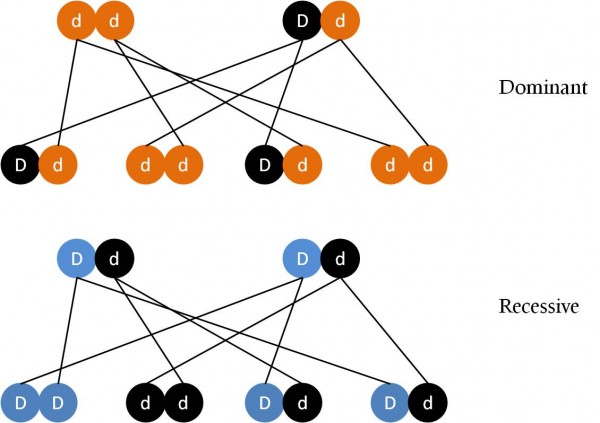

Figure 1. The inheritance of dominant (top) and recessive (bottom) genetic conditions. If a trait is mediated by a dominant gene (D), statistically half the offspring will develop that trait. If it is mediated by a recessive gene (d), both parents must carry the gene in order for only one in four to develop it, however two in four offspring will carry it.

The genes that cause TSD are recessive, meaning that the condition is only observed in an individual if both parents carry the recessive gene (Figure 1), such that a recessive copy from both parents is inherited. The chances of acquiring a recessive genetic condition are therefore one in four under these circumstances. Additionally, if both parents carry the recessive gene in their genotype, two in four (one in two) of the offspring will also carry the gene (but not suffer the disease). If only one of the parents carries one recessive copy, statistically none of the off-spring will develop the condition*. . The only way a child could develop the condition under those circumstances was if a serious mutation occurred, leading to two copies of the recessive gene being present.

TSD is also known as GM2 gangliosidosis. This is because the condition centres around the breakdown of ganglioside GM2, a lipid found in nerve cells (neurones, Figure 2). In TSD, the ganglioside is not broken down and so it builds up in lipid-storage organelles in cells, called lyposomes (Figure 3). The failure of the ganglioside to be broken down, is caused by the absence of an enzyme called β-N-acetyl hexosaminidase. The build-up of ganglioside GM2 that then occurs causes cells to die (Stryer 2000). GM2 gangliosides are particularly common in the nerves of the brain and spinal cord and so when those cells die, the symptoms of the disease are observed through changes in the behaviour of those systems.
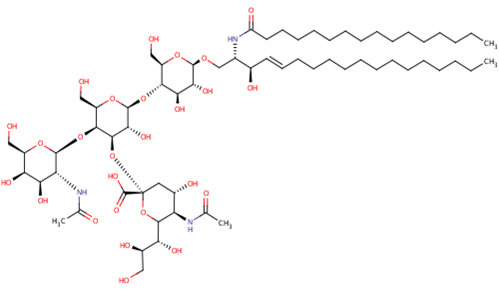

Figure 2. The molecular structure of one of the gangliosides that sufferers of TSD are not able to metabolise (break down by hydrolysis)

The absence of the required enzyme is a result of mutations or errors in something called the HEXA gene (NCBI website, 2012). This means that the enzyme is not synthesised in the same way as it is in unaffected individuals during protein synthesis. This is because amino acids in the primary sequence are missed out (causing a frame shift), or are replaced with others. This means that this globular protein does not fold up properly and so the active site in the normal β N acetyl hexosaminidase does not form, causing the catalytic activity of the protein to be either drastically reduced or entirely absent.
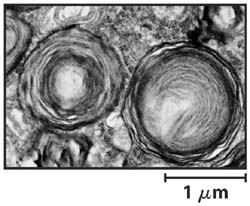

Figure 3. An electron micrograph of spinal cells from a sufferer of Tay-Sachs disease, Nelson & Cox, Lehninger Principles of Biochemistry. This picture shows the enlargement of lyposomes (by a factor of 100) on accumulating gangliosides.

The clinical symptoms of TSD include muscle weakness and poor muscle co-ordination (ataxia). The combination of these means that normal movements, such as crawling and turning over, stop before the child is a year old. The patient quite literally is unable to move him or herself; the nerves connecting the brain to the muscles just do not work. After this time, nerve function is reduced still further, causing sufferers to go blind and deaf. There is also a characteristic formation of spots on the eyes that are cherry-red, which is a symptom unique to this condition and is taken as a strong diagnostic sign. Paralysis is also common in the latter stages of the disease, before death. Death normally occurs before the age of 3 years (Desnick and Kaback, 2001). The condition is thus very serious and the opportunity for care is basically absent.

There is a form of TSD that appears more slowly, though this is rarer than the usual form. This is known as late-onset Tay-Sachs disease. The same symptoms are evident, by their progress is a good deal slower than in the more common (infantile) form. The cause in this case is too little of the enzyme to break down the ganglioside effectively. This arises because of a fault with the gene that regulates the synthesis of β-N-acetyl hexosaminidase from the HEXA gene. Another possibility is that the enzyme that is produced is only slightly mutated and so it does have some catalytic activity but that this is much less than the healthy form.

It is now possible to diagnose the condition during pregnancy, where a sample is taken and tested for activity of the enzyme. If there is little or no activity, it is asserted that the enzyme is absent and that the child has the condition. Statistics from America suggest that, in that country, about 3% of Jews originally from eastern Europe (Ashkenazi) carry the disease, with only 0•03% of the general population being carriers (Stryer 2000).

There are also ‘pockets’ of the condition elsewhere in North America, with evidence for it in communities in Pennsylvania, Louisiana and Quebec (Desnick and Kaback, 2001). As the number of carriers of the condition is relatively low, and so closer-genetic breeding (such as first- and second-cousins) is required for the chances of two carriers to be statistically likely, the impact of this condition is low. However, the effect of the principle form of the disease (infantile-onset) on the individual is clearly severe, and thus heartbreaking for the family. The occurrence of the condition in a child will raise the question of which other children of those parents may be affected, and how further pregnancies should be managed.

Religious belief may also influence this. In Jewish religious law, there is not a clear policy on abortion and so parents of Ashkenazi Jewish extraction may be able to abort pregnancies in which the foetus has Tay-Sachs disease. However, prospective parents in places such as Pennsylvania and Louisiana may not be able to do so, as much of the United States of America is decidedly anti-abortion. Thus in the few cases where babies are born with this condition, questions about the compassion amongst an anti-abortion approach may be raised.

Current medical thinking suggests that the only feasible option for dealing with both of these conditions is through preventative medicine. This means that clinicians and physicians use strategies and methods to prevent the disease occurring or starting, rather than trying to change it (management) or undo it (cure) once it has started. Although this would clearly be effective, and prevent disease occurrence, unfortunately it raises a variety of ethical questions for religious people, particularly Christians, who find themselves unable to exert any personally-driven influence on the process. This is particularly relevant for TSD, which occurs in strongly protestant communities in parts of the USA (Louisiana, Pennsylvania). Such steps include screening pregnancies for the conditions. Another option is fertility treatment in which several ova and the resulting embryos are screened for the condition(s) and those found to have it are discarded, ensuring that the condition does not propagate to the offspring but that they are ‘their’ children. Aborting pregnancies in which the condition(s) have been detected is also an option, though the prospect of this is quite emotionally, as well as religiously, difficult.

Despite this, the study of these conditions has produced a good deal of understanding of both the conditions themselves but also about genetic inheritance and the effect of neurological disorders, both short- and long-term, on the body. Without a concerted effort to avoid these conditions through preventative measures, the conditions will never disappear altogether. Additionally, further random mutations may occur, leading to a re-emergence of these diseases, or ones that closely resemble them.

References and Notes

* This method of recessive inheritance is also how ordinary traits such as eye and hair colour are inherited.

L. Stryer – Biochemistry, Fourth edition, 2000, 0716720094

Tay-Sachs Disease, Ed. Robert Desnick, Michael Kaback, 978-0-12-017644-1, Academic Press, 2001.

Further Reading

NCBI reference website, http://www.ncbi.nlm.nih.gov/books/NBK22250/ (accessed January 2012)
 How Hot is Hot? A Burning Question About a Hot Condiment Thursday, Jan 19 2012 

Plenty of people like a good hot curry. I am not one of them, but I think that most people have met, or know, someone who likes wolfing down the hottest curry in the house as a matter of pride. I do know someone who likes to munch on the same kind of hot curry but exquisitely slowly. Either way, it is safe to assume that pretty much anyone who has had a strong curry, and either enjoyed it or not, will remember the flavour forever.

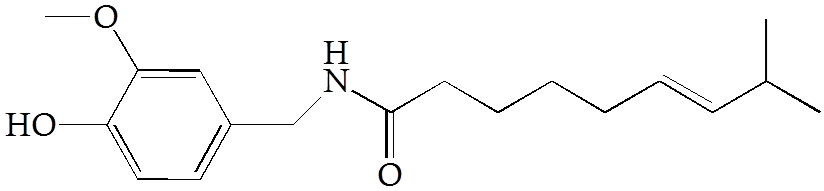
There has even been a certain amount of study on this topic: some time ago, the compound capsaicin (Figure 1) was identified as the cause of the hotness. Several related compounds have also been identified, some of which are ‘hotter’ than others. This led to the desire to measure the ‘hotness’, resulting in the Scoville Heat Unit, and the Scoville Scale.

There is also the well-known opportunity for a schadenfreude with curry flavours. As it can be a strong flavour, when someone bites on something unexpectedly teeming with chopped jalepeños, the shock on their face is palpable. However, this shock can also be turned on its head with respect to public order. Recent anti-capitalist protests in America have given rise to some disturbing images of people sprayed with a capsaicin formulation (commonly known as pepper spray) either intentionally, or apparently not.

While these are shocking, and the mental and physical distress caused by the use of this ‘riot-control agent’ are readily understood, other factors are also important. The use of pepper spray as a weapon of self-defence, against a rapist or criminally violent attacker for example, seems not unreasonable. However, the link between pepper spray and deaths in people exposed to it who also have compromised respiratory function, increases the interest in managing the use of pepper spray, both politically and scientifically.

Figure 1. The structure of capsaicin, showing a more polar section (left) and a more lipophilic one (right), giving rise to a comparison with lipid structures.

One way of taking things further is to understand the science behind what is happening when pepper spray is used. A judgement can then be made about safety and appropriate conditions for use. The structure of capsaicin (Figure 1) suggests that it has a lot in common with what we know about lipid structure – a relatively polar (hydrophilic) section as one end, and a lipophilic hydrocarbon chain as the other. However, it is not just the lipid-like properties of capsaicin and its related compounds that give rise to the effect we remember so readily – after all, we eat lipids of one sort or another in almost every mouthful and most do not have the same effect as a vindaloo on our taste buds. This hot sensation is due to an effect of the capsaicin on nerves that feel heat (thermoception) and pain (nociception).  Recent work has suggested that there is a direct impact on the activity of calcium channels in nerves and earlier work has found that such exposure was responsible for permanent damage to the cells involved.This is quite sobering when looked at from a riot-control angle. If a chemical is able to cause innervation, as measured by pain, it is arguable that it is a drug. If it is a drug, strict licensing laws would apply. This also influences the dose(s) that can be used legally. Perhaps we need to reflect on the use of pepper spray of indiscriminate dose, as a crowd control agent?

 Suet: A Protective Subject Thursday, Jan 12 2012 

It all started with a Tweet. “Are you watching Only Connect?  There’s a round about lipids” came the missive from an excited lipid-watcher.  To my lasting regret, I was not in front of BBC2 at that moment.  I did however catch it on iPlayer a day or two later.  The round included sunflower oil and suet.  The latter was the one that stood out to me.  Suet is something I had heard of as being in pastry, and definitely in mince pies, so I was sure it did actually exist, but wanted to pin down why it was grouped with things like olive oil and sunflower oil.

My first port of call was the bookshelf.  Michel Roux’s book ‘Pastry Savoury and Sweet’ makes no reference to suet, and perhaps more surprisingly, neither does my concise Larousse Gastronomique.  Delia makes just one reference to it in her Complete Cookery Course, as an ingredient in savoury pastry, but this is not quite a treatise on what suet is.  What she does say, is that it is a heavy fat from beef.  Although this is by no means wrong, lipid chemists would refer to it as a saturated animal fat, mainly composed of stearic acid.  More specifically, the suet sold in supermarekets is actually pebbles of fat that have been caked in wheat flour in order to stop them sticking together.

But where it comes from is a bit more gruesome: it is the fat used by the bodies of cattle, sheep and pigs to cushion abdominal organs such as the kidneys. When it is first removed from a carcass, it is therefore a sort of white lump.  However unpalatable this may seem on the face of it, in order to make our own bodies properly, similar materials are useful to us.

As all ardent bakers will know, is impossible to make pastry without a source of fat. Generally this is butter, and just occasionally it is from another source.  For savoury pastry, such as that in a esteak and kidney pie, it is seen as ideal as it goes well with these flavours.  Beef dripping can also be used, but this is the fat from beef that has been cooked.  However, as this is liquefied, it will have lost some of the constituents that would otherwise be in suet, such as the protein.

So, we have our answer. Suet is indeed not really a lipid, but a fatty isolate from raw animal carcasses.  It is also typically as fatty as olive oil, but, as it is saturated fat, it is a solid at room temperature.  That makes it a bit tougher than oil, and actually tougher than butter too, and, as anyone who has rolled several types of pastry will know, that makes it easier to roll out.  Also, the fact that it is a solid at room temperature means it can give a thicker texture to foods such as mincemeat.  No wonder it has been used for hundreds of years for making the perfect pie.

 Bending in Two Different Directions at Once Saturday, Jan 7 2012 

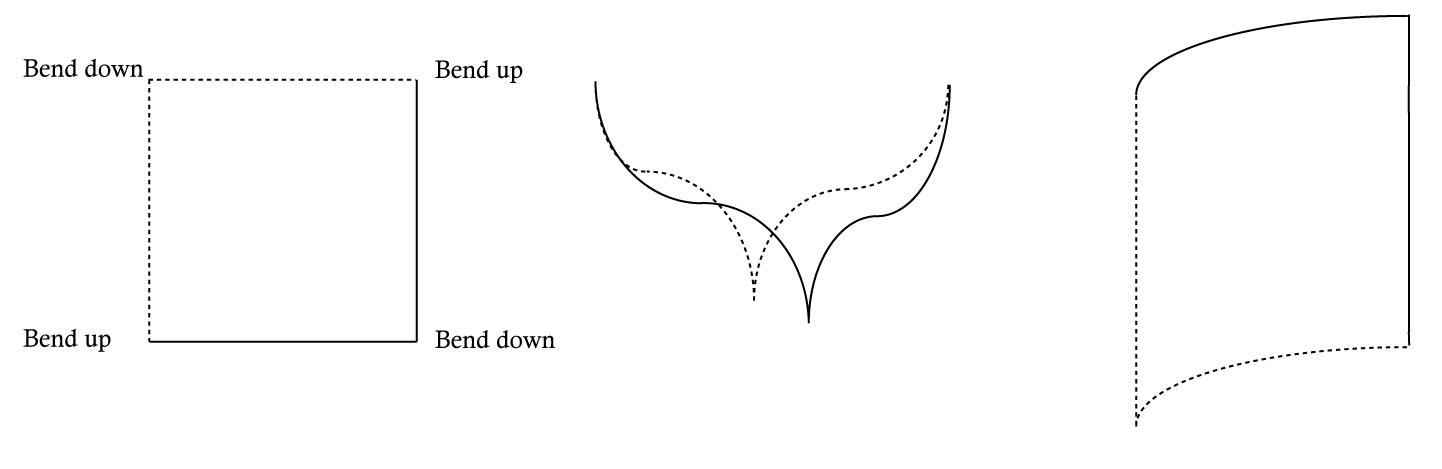
Have you ever tried to bend a piece of paper in two different directions at once? If not, try it with a piece of paper about 5 cm by 5 cm: hold the sheet of paper in front of you, bend the top left and bottom right corners up, and the other two corners down (Figure 1, left and centre). You may need someone else to help you, but either way, you will quickly find that it is impossible to bend the piece of paper in this way without it either tearing or creasing. This is in contrast to the effect of bending the paper across its middle, i.e., bending it when holding the two pairs of adjacent corners, where it happens readily and without tearing (Figure 1, right).

Figure 1. Diagram of the effect of trying to bend a square sheet in two different directions simultaneously (left and centre). Does it work with a sheet of paper?

It is easy to imagine that the first kind of bending, the one that tore or creased the paper, will work better with a flexible material such as rubber.  It is also obvious why: the rubber can stretch, it is elastic.  Paper lacks this quality, and as the applied force overcomes the forces holding the sheet together, the sheet breaks.  We know that bilayers are sheets, and so this begs the question ‘What happens when we try to bend a sheet of lipids?’

It would obviously be useless if the lipid bilayer were like the sheet of paper: moving your hands to type, or moving your eyes to read this sentence, would result in the rupture of many millions of your cells.  That does not have an evolutionary advantage and so, by this stage in cellular evolution, it no longer occurs.  Nature has developed a way of ensuring that cells have a measure of flexibility in their membranes to cope with applied forces.  This includes forces from within the body, such the pressure between forearm and upper arm, of folding an elbow, or peristaltic activity in the small intestine.  It can also be external ones such as air, or water, pressure.

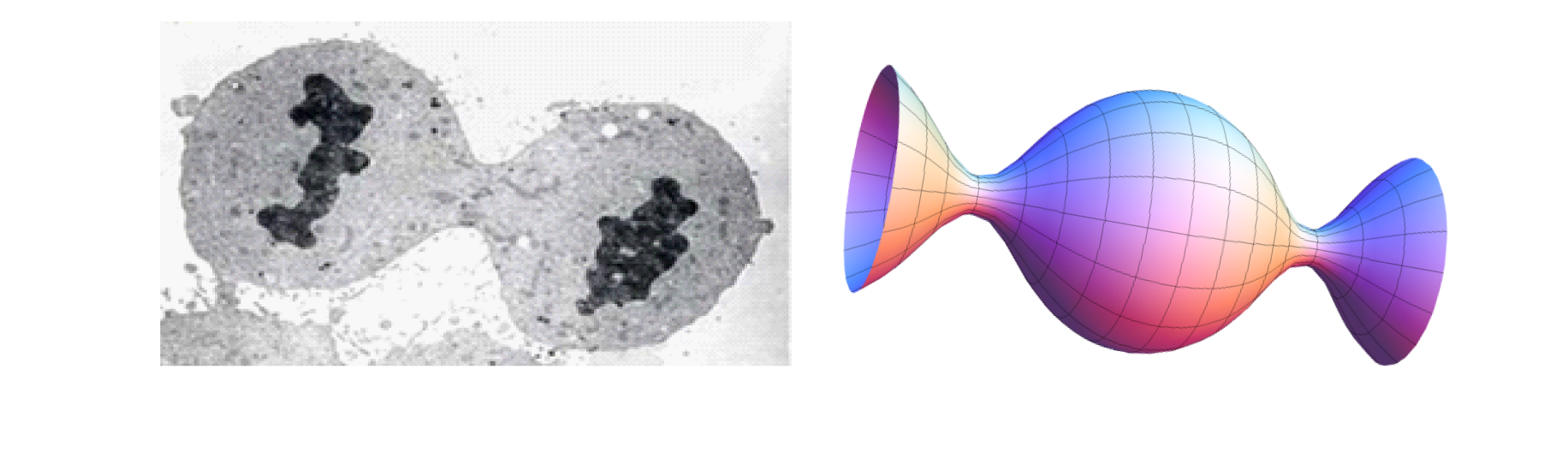
Figure 2. Left, cell division at the stage shortly before membrane fission. Image courtesy of Harold C. Smith, University of Rochester, Rochester, NY, USA. Right, unduloid surface analogous to that observed in vivo, with curvature in opposite directions simultaneously, shown here in a repeating manner. Image courtesy of David Dumas, University of Illinois at Chicago (2010).

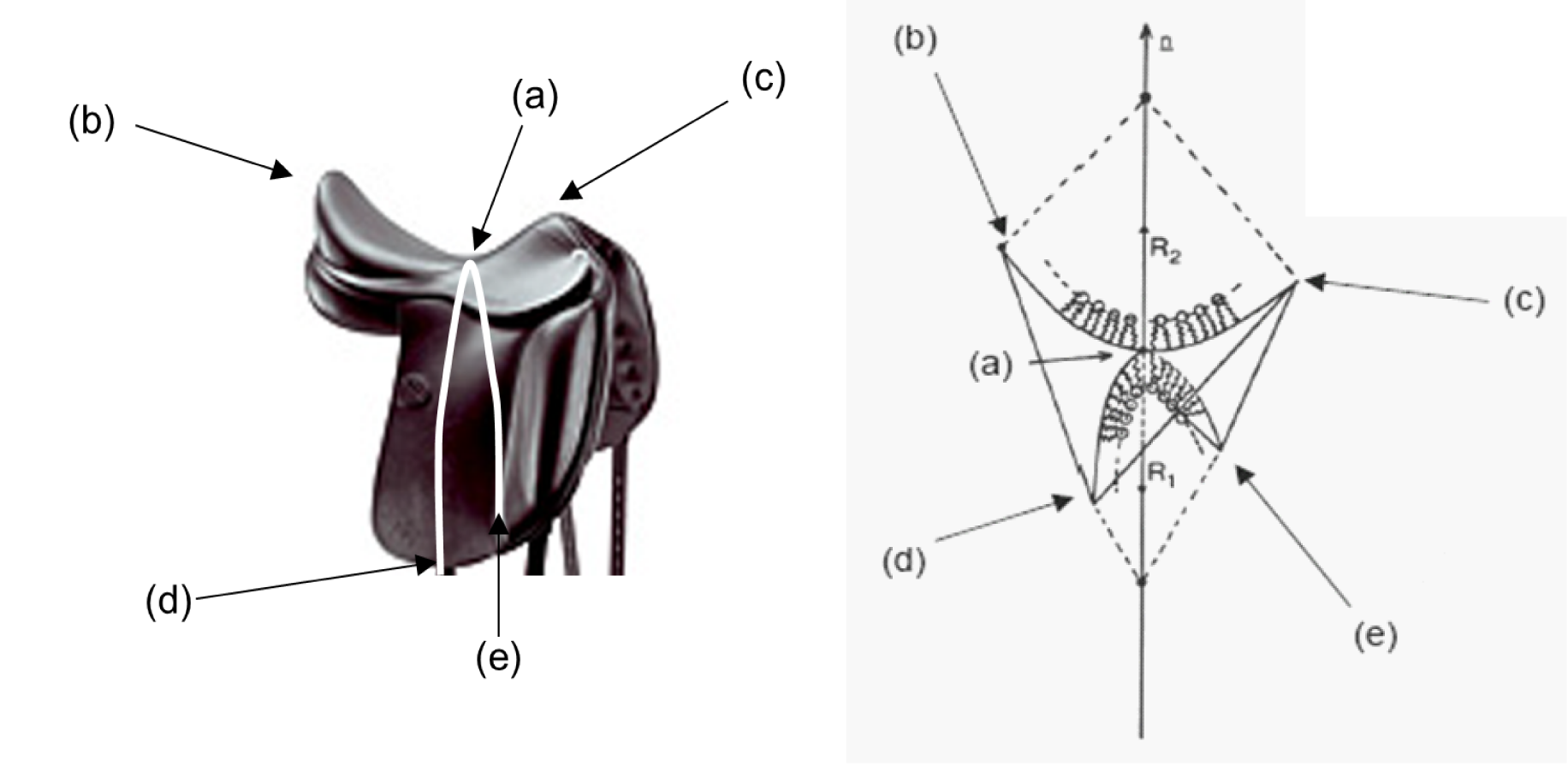
Figure 3. Left, saddle shape shown on a leather dressage saddle, with the curve that is perpendicular to the plane of the paper shown in white. Right, saddle formation of the lipid molecules, where the curvatures are at perpendicular planes (J. M. Seddon, R. H. Templer, 1995, Polymorphism of Lipid-Water SystemsfromThe Handbook of Biological Physics, ed. R. Lipowsky, E. Sackmann, Elsevier Science). Points: (a) Saddle point or seat, i.e., where the two curves meet and there is curvature of both negative and positive sign at once (In practice this is restricted to no more than one lipid molecule), (b) Left (arbitrarily assigned name) apex of the upper curve, (c) Right apex of the upper curve, (d) and (e) are the apices of the lower curve.

Clearly there are limits to what we can endure. Other species have different adaptations, however.  Anybody who likes penguins will know that they are quite happy with the (air) pressure on land, but also can dive and swim at considerable depths in the sea.  This is a huge range of pressures, and it is not an accident that penguins are adapted for this breadth of conditions.  The physical requirements are not just for strength, e.g., to breathe despite the external pressure, but also for physical resistance to pressure at a cellular level.

Although this may seem unexpected, there is more (and in my opinion this is the most interesting bit).  Whilst we understand how the cell membrane is constructed (well beyond the point of knowing that biological membranes are not flat), and what a membrane does, we also know that in order for you to be reading this now, millions upon millions of cells have had to reproduce, fight infection and communicate with one another.  And that is just in your body, carries on all of the time and hopefully without your being aware of it.

What all these processes have in common is that they involve membrane-dividing, or membrane-fusing, events as a crucial stage.  And all of these things must occur despite applied pressure, and changes in this applied pressure.  There is no evolutionary advantage to forcing a penguin to stand still for a while, such that its cells can divide without changes in pressure.  So how does the body do it?  Well, there are several things, not all of which are lipid-based.  Mammals and birds have a skeleton, which helps give support to the whole body. Although not the full answer at a cellular level, it is undoubtedly a helping hand.  At a lipid level, the rest mainly consists of enzyme (protein) action causing changes in the desired shape of lipid molecules.  So, if the action of an enzyme means that a lipid is no longer cylindrical, but wedge-shaped, the thermodynamic driving force for bending the membrane will start to emerge.  This can be particularly intricate, and can even be responsible for driving the membrane to bend in two directions at once (Figure 2).

A surface bending in opposite directions simultaneously is described as having negative Gaussian curvature. Despite its obscure-sounding name, the concept of something flat bending in two directions at once is not unique to cells.  Figure 3 shows an example of this, the seat of a saddle. A bilayer can be draped over the same shaped surface in order to give this shape.  Cells exploit this topology as an intermediate in division (Figure 2).  Not only does the cell exercise control it for this process to occur, but it does it despite external pressures, both internal, and external.

 Olive Oil: A Great Swindle…That Wasn’t Saturday, Jan 7 2012 

As a geeky teenager, I used to read the nutrition information labels on foods for entertainment.  Early on, I noticed a few things that sounded somewhat peculiar out of context.  For example, I was stuck by how difficult it was to guess what a food was from its nutrition information.  This worked both ways though: what foods had in them was quite difficult to guess just from knowing about them.  Years later I realised that this is the sort of thing that some food scientists work on.  I learnt that we have ended up thinking that water is the healthiest food around, chiefly because it has nothing in it.  I also saw that olive oil is only ninety-something per cent fat.  Sugar, on the other hand, is a full one hundred per cent carbohydrate.  Health benefits aside, I was immediately intrigued by this revelation.  (a) Why was something called ‘oil’ not completely oil, and (b) How could manufacturers get away with olive oil not being the full monty? Looking at different bottles, to see whether it was just that one I found out that some were 85% fat and some were more like 95%.  This prompted my third question (c) Why did it vary so much? The difference between 85 and 95% at is a bit of a shift for something that has the same name.

It was my first inkling that both marketing and food scientists had a lot to answer for.  However, the drama was moot in any case: TV chefs rattled on as much about good ingredients then as they do now, and cheap stuff was not as good as expensive stuff then either–so the chances were we were not being duped on a big scale.  The question remained though: What is the stuff in olive oil that is not fat?  What we need to do to answer this question is a bit of scientific analysis.

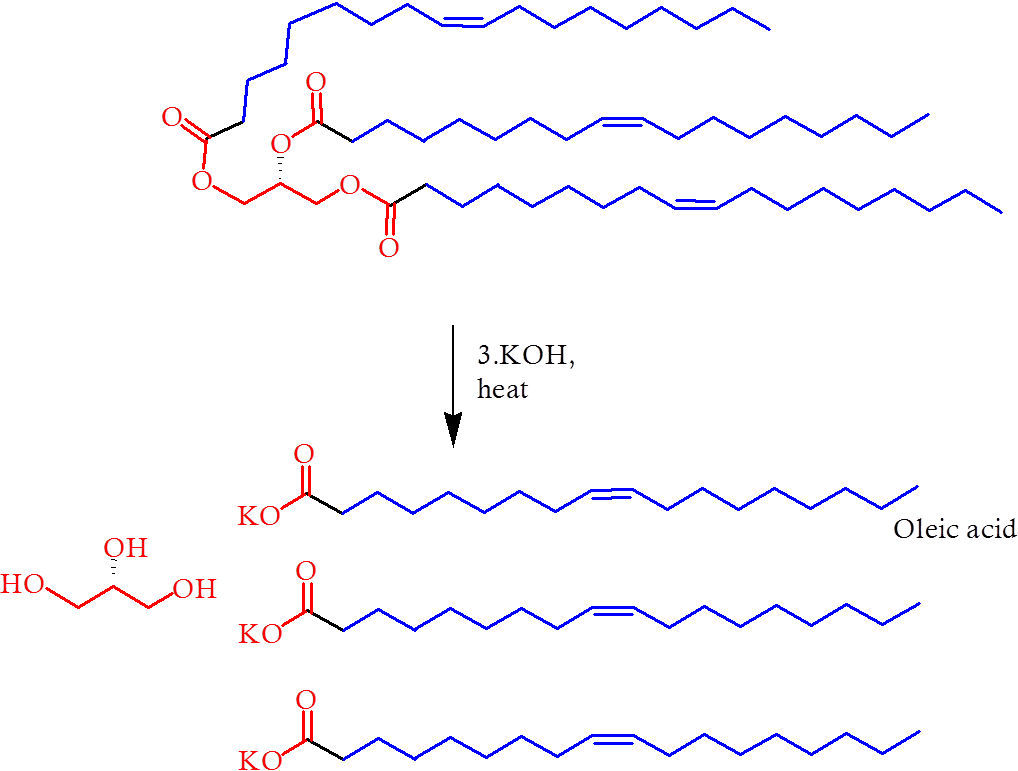
Nuclear Magnetic Resonance (NMR) Spectroscopy tells us that the dominant compound in olive oil is a triglyceride made, mainly, of unsaturated fatty acids. A typical triglyceride is shown in Figure 1.  One of the other ways we know it is a triglyceride, and the method used before NMR was invented, is by studying how it reacts with other chemicals.  Specifically, if one part triglyceride reacts with three parts of potassium hydroxide, to give three parts fatty acid and one part glycerol, it was seen as bona fide triglyceride.

Figure 1. The saponification of a triglyceride (top), giving rise to glycerol (bottom left) and three moles of fatty acid (bottom right).

 This reaction (Figure 1) is also the key to why olive oil is only ninety-odd per cent fat – apart from the green colouring. A calculation of the molecular masses tells us that glycerol represents around 10% of the mass of triglycerides, which is not a fat. This is why olive oil is not 100% fat. Expert bakers will tell you that glycerol, also known as glycerine* is quite sweet to taste and dissolves in water. It is also used to stop icing becoming dry and brittle. It is thus not a fat, and so is not listed under the fat content on the nutrition information.

When I realised this, I was a bit surprised at my original view. My reaction to the contradiction I first saw had been turned inside out. Now I know that olive oil that does not have 100%, or nearly 100% fat in it, because it is principally composed of triglycerides rather than fatty acids.  As this means it has probably seen less processing than other foods, it is therefore likely to be of a better quality. This also reflects well on the materials used to make it, because good olive oil does not need to be processed at all.

*Also used to make nitro-glycerine, the explosive that is in dynamite