Dr Samuel Furse » 2011 » October

 Ransom™ Pure Lecithin – Product Review Wednesday, Oct 26 2011 
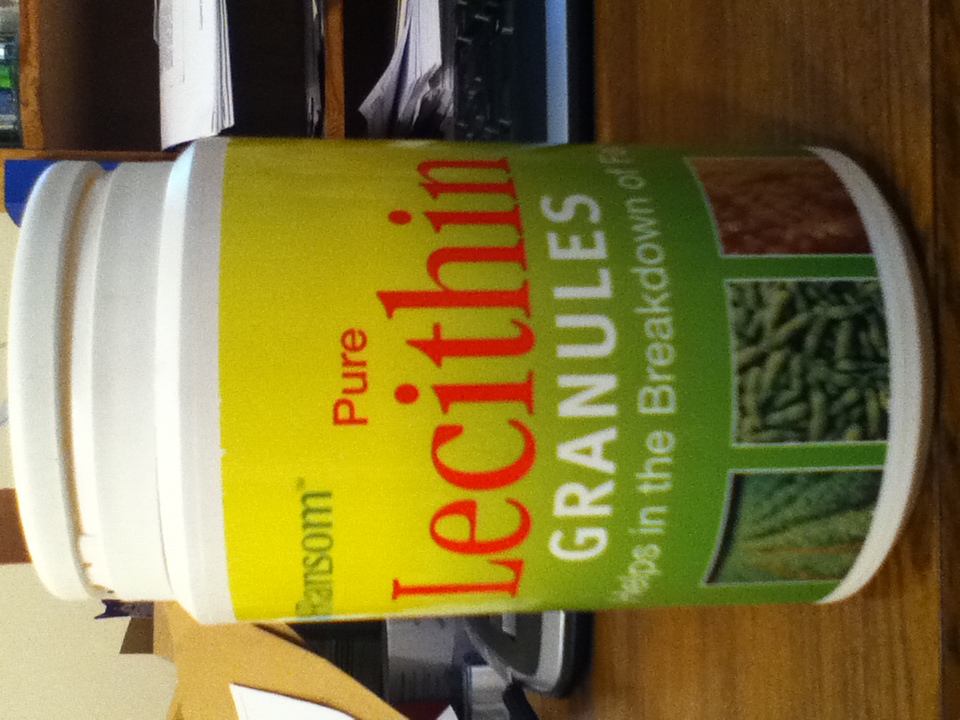

Figure 1. The “Pure Lecithin” produced by Ransom™ Image © Samuel Furse MMXI

It is not very often that something is so clearly adrift that I think it needs critical analysis.  This, however, is one of those times.  “Pure Lecithin Granules” produced by Ransom™ is a very innocent-looking product (Figure 1).  So what is there that could be to discuss?  I could be about to examine Ransom™’s legal position with respect to this product, or their marketing, or their science.  The label is green and yellow, and it has pictures of clean-looking vegetable matter on it (see photograph Figure 1).  So they probably have their marketing fairly well nailed.  I am not trained in law at all, and so that aspect I leave alone at present.  That leaves us with the science. The first thing that caught my eye was the phrase “Pure Lecithin”.  In lipid chemistry (and membrane biophysics) the term ‘lecithin’ means phosphatidylcholine.  This is bourne out by the products available from reputable suppliers such as this one and this one.  ‘Lecithin’ is an informal word and so there is some flexibility over its meaning, but this only extends to the detail of the fatty acid residues  (Figure 2).  This is where the use of the word ‘pure’ by Ransom™ meets its first serious slippery patch.  Lecithin is by definition a mix of phosphatidylcholine molecules, thus a concept of ‘pure’, seems at best imprecise.  Further, the very detailed nutritional information on the packet shows that there are at least four molecules present that are not phosphatidylcholine (‘real’ lecithin).  Three of these are the lipids phosphatidylinositol, phosphatidylethanolamine and phosphatidic acid.  The fourth is listed as “carbohydrate”, and is presumably yet another mixture.  Thus ‘purity’ with respect to this product is therefore debatable. The second phrase that leaps out with crashing force is “helps in the breakdown of fat”.  That suggests to me, as a consumer, that this stuff will not only help your body deal with fat in a way that is harmless to you but also basically reduce the amount of fat you will gain from the food you eat.  This phrase is therefore a good piece of marketing — it sounds good, but means almost nothing. What is true is that this collection of lipids (with a bit of carbohydrate), will help to dissolve fatty materials in water and form an emulsion of the fat and the water.  The “Lecithin” is therefore an emulsifying agent.

Figure 2. Phosphatidylcholine (Lecithin). The red section represents the hydrophilic (water-loving) section, where the blue represents the greasy-loving section. The latter is typically a mixture of types in lecithin.

It is perhaps not surprising that it has a molecular structure that is chemically sympathetic to both water and fat.  It is well known that water and fat do not mix.  That lipids allow this to occur makes them the metrosexuals of chemistry in that sense.  However, the fact that there are similarities between lipids and fats might ring alarm bells for you.  And you would be right.  As it happens, the molecules that make up fats, called fatty acids, form part of the molecular structure of lipid molecules.  In fact they are the weightiest part (see Figure 2).  This is why this “Pure Lecithin” is in fact 91% fat by mass.  So much for helping with the breakdown of fat, and being good for a healthy diet. 

So after deconstructing their presentation of anything even vaguely scientific, or indeed apparently healthy, do I have anything good to say about this product?  Well, sort of.  Mixtures of lipids are occasionally useful to me as a research scientist, with known components such as this it can provide a vague sort of comparison for other, unknown, lipid systems.  It provides a cheap source of such a mix of known lipids and so ideas about lipid experiments I have in the bath or at other inopportune times can be tested without spending much money.  But would I use it in food?  Certainly not.  It smells of nasty paper glue in my opinion and gets awkwardly sticky if it goes near water, even if we ignore the above shortcomings.  It may seem unkind, as they clearly go to some trouble to produce a food-grade product, however when something appears ill-presented on close inspection, could I really trust it?  Fat chance.

 

 What is a Lipid? Tuesday, Oct 25 2011 

For most people who have heard it, the word lipid sounds like the scientific word for fat. Although scientists tend not to use the word fat, and do tend to use the word lipid, the two do not quite match-up. When we say fat in the context of food, we think of cooking or olive oil, butter, grease and possibly cream. Perhaps confusingly, all of these have lipids in them, but none of them are pure lipids.

The confusion about these strange molecules is probably related to the fact that they are hard to pin down. There is virtually an art form in isolating them. Only in the last 50 years have we really started to understand them, or their role in biology. The thing that makes lipids what they are, is that they are what is known as amphiphilic. This is from the Greek ‘amphi-‘, meaning ‘both’, and ‘‑philic’, meaning ‘loving’. Although this sounds like an intellectual’s way of referring to a bisexual person, here the ‘both’ refers to water and grease. As we know, water and grease do not mix: if we pour oil onto water, the two just sit there. Lipids are special because they can dissolve in both of them. This property can even be used as a way of mixing grease and water together. Homogenous mixtures of grease and water with another agent are known as emulsions. Examples include milk, cake batter and margarine. The emulsion as a construct is useful in the manufacture of foods, giving rise to a plethora of agents that are able to perform this role, namely emulsifiers. Although in theory all lipids can be emulsifiers, not emulsifiers all are lipids.

We can see the roots of the amphiphilic behaviour in the structure of the lipid molecules. Moreover, structural analysis of molecules can help us determine whether or not a molecule is a lipid at all, and if so, which sort. Figure 1 shows an ordinary lipid with the head (water-loving) and tail (grease-loving) regions marked out.

Figure 1.  Phosphatidylcholine (Lecithin). The red section represents the hydrophilic (water-loving) section, whereas the blue represents the greasy-loving section.

The structural approach has been used by several institutions in recent years, including Lipid Maps.  This has given rise to a broader definition of the term lipid.  Thus, a variety of compounds not traditionally referred to as lipids are included, even if they are not measurably amphiphilic. However, when these ‘sort-of lipids’ are inserted into lipid systems whose physical behaviour is well understood, their influence on the character of the system is measurable.  This influence of the added component is also described as concentration-dependent, i.e., the more of the molecule that is put in (the higher the concentration), the stronger the given effect.
Some of the most amazing and unexpected behaviour of lipids occurs when they are exposed to water.  As part of the molecule likes water, and part of it does not, you can imagine that this situation is not going to be simple for the poor little lipid.  We as scientists describe the stresses and strains in systems like these according to the laws of thermodynamics.  Those of a certain generation may like to remind themselves of the Flanders and Swann song at this point.  Either way, we have put an unsuspecting lipid into a system with water and so what does it do?  Generally, lipids will self-assemble.  The exact manner in which this occurs varies between types of lipid, but the principle is observable across all of them.

The principle of self-assembly can be explained in terms of two competing priorities.  Thermodynamics means that the grease-loving (lipophilic) part of the lipid molecule wants to be shielded from the water, but at the same time, the water-loving (hydrophilic) part wants to be in touch with the water.  As our lipid cannot bear to disobey the laws of thermodynamics (who would?), it arranges itself in order to compromise between these competing forces.  This compromise can also be described in terms of energy.  In order to adopt a position in which the greasy section is exposed to water requires a lot of energy.  When the energy that is available to the system is insufficient for this, exposing the greasy section of the lipid to the water is described as energetically unfavourable.  This is the thermodynamic law I refer to and is also known as the hydrophobic effect.  The latter term, as you might well guess, is from the Greek ‘hydro-‘ meaning ‘water’ and ‘‑phobic’ meaning ‘hating’.

The hydrophobic effect may sound obscure, but the forces involved in it are what hold the membranes of cells together.  This means it has a huge and unsung part to play in understanding biology.


 Introduction Tuesday, Oct 25 2011 

Lipids are not sexy.  They do not give anyone erotic stirrings, they do not start revolutions or catch criminals.  However, without them, life as we know it would simply not exist.  Let me explain.

Cells are well known as the smallest units of life.  Their discovery in London in the 17th century by Robert Hooke raised, and continues to raise, a bewildering array of questions:  ‘What makes them alive?’ ‘What molecules are cells made of?’

We now understand that there are only about three types of large molecule that make up the physical blocks of life.  Nobel Prizes have been won for work on two of these, namely, DNA [1] and proteins [2].  The understanding that work on DNA and proteins has given us has led to other questions.  For example, not only has the structure of DNA been discovered but its’ purpose is now also understood.

The link between these first two classes of molecule is that the DNA codes for the proteins.  DNA is divided up into genes, and one gene codes for one protein.  Proteins are the machinery that allow cells to work.  With proteins, cells can exert control on the chemical processes that are essential to survival.  But what about the bits in-between the proteins in a cell?  What about the bricks and mortar that hold the cell together?  It is a good question.  This is the job of the third class of large molecule that makes cells what they are: lipids.

Windows, doors, tables, chairs, bookcases and novelty vacuum cleaners all tell you a lot about a house.  But, like the proteins of a cell, they need something to hold them together in order to make them a house and not just the contents of a skip.  In building a cell, that job falls to lipids and therefore the analogy with the brick is not as distant as it might sound, either metaphorically or practically.

Lipids come as many varieties, though they are rarely unique.  Individual parts are never a focus when looking at the whole construct, but of course we notice when they are not there.  And when they are there they do not seem to do much.  But they have a physical job: crudely, they fill up the space in between the more interesting bits and hold them in place.  This is perhaps why they have not received as much scientific or media attention as other components of the cell.  This is why they are not ‘sexy’.  In any case, they are better than that.  They are useful.

References

[1] F. H. C. Crick, J. D. Watson, M. H. F. Wilkins, Nobel Prize for Physiology, 1962.  http://www.nobelprize.org/nobel_prizes/medicine/laureates/1962/

[2] L. H. Hartwell, T. Hunt, P. M. Nurse, Nobel Prize for Physiology, 2001.
http://www.nobelprize.org/nobel_prizes/medicine/laureates/2001/

 W-words, N-words, and Victoria Coren Stealing My Act Sunday, Oct 16 2011 

An all-too-rare occurrence came to pass this morning. I read Victoria Coren’s Observer Column.  I say all-too-rare partly because she does not write them quite every Sunday, but mainly because I am far too lazy to read them regularly.  On this rare occasion, I was struck in a way that made me want to read back through her other work.  This was to see how much of my stuff she had nicked ahem overlapped with.

I hesitate at this point, not because of the libel suit that is no doubt heading in my direction, but because she has done something that I want to do.  I want to write in a way that makes people read more of my stuff.  It seems reasonable to suppose that Miss Coren has not contrived to make people read her back-catalogue to research possible plagiarism, but something is going right nevertheless: she writes for a national newspaper and I do not. I write for a few different things, some of which I am paid for, many of which I am not.  The text you are reading is on a website that would not be here if I had not organised and coughed up for it.

The notion of wanting people to enjoy reading what one writes seems more fun, and more informative, than writing to persuade, or indoctrinate, or, as a piece of personal cathartic therapy. It is also a much better positive re-enforcement than any other reason – watching someone laugh at a joke you have put in an article is great. Better still if they do not know whom you are, or know you have seen them.

This business of having work published is made of two halves. First, you have two write something that someone else (an editor) thinks is good enough and right for a publication.  Second, that publication has to be read.  How do you do this?  ‘Write well’ is an obvious thing in general, but one has to stand out from others.  One can be sensationalist, insightful, funny, or the cheapest of the lot, just mention naughty words to get attention.  For attention alone, it has got to be something that if used ordinarily is deeply offensive and racist like nigger or wog, as piss and fuck and bollocks just do not work any more.  At least that is what my agent tells me.

In reality, Miss Coren has not stolen anything of mine at all. I have written about eating meat, and even managed to get both cannibalism and vegetarianism into one piece.  Equally, however, I have never written about Hugh Fearnley-Whittingstall, farming puppies, or eating a pet cat. (Is that enough for the lawyers?  Probably not.  At least a lawsuit will give me something to do alongside, you know, Science).

A second reason why I lay no claim to being behind what she wrote is that it was obviously wrong. Well, sort of.  What she wrote was sort-of twisted and weird, and a bit negative in that way Guardian columnists do.  I stress the phrase “what she wrote was wrong” and avoid saying “she was wrong”.  There is a distinction between a writer and their work. Of course it could be that she really does think that what she wrote is true, and that when Hugh F-W flash-fries puppy haunches on BBC two she (or more likely her brother) will be there to gobble it down approvingly.  However, what I think is more likely is that this highly intelligent, experienced, Oxford-educated writer, has her audience nailed.  It is not just Guardian columnists that write in that sort of way, it applies to the feature writers and journalists at that paper as well.  This facility on her part should come as no surprise.  The paper is a product to be sold.  The proprietors want their columnists to write what fits into that sort of mould.

That statement sounds rather like it pigeon-holes her work, but as she has written for several other papers during her career, including the Guardian’s arch nemesis, The Telegraph, such compartmentalisation would be flawed.  She has to write for an audience. It sounds obvious and easy but it is a far cry from many writers.  I once went to a literary event at Foyles at which Nicola Morgan gave a talk/marketing-do for her new book about how to be a publishable writer.  The questions session afterwards started with an articulate-sounding man who asked how he could deal with negative feedback about his work without killing the person it came from. This is, needless to say, a far cry from someone like V. C. who holds down a regular column in a national newspaper and writes books. I suppose the annoying thing for the rest of us is, does she have to be quite so good at it?


 E Numbers: Emulsifiers Sunday, Oct 16 2011 

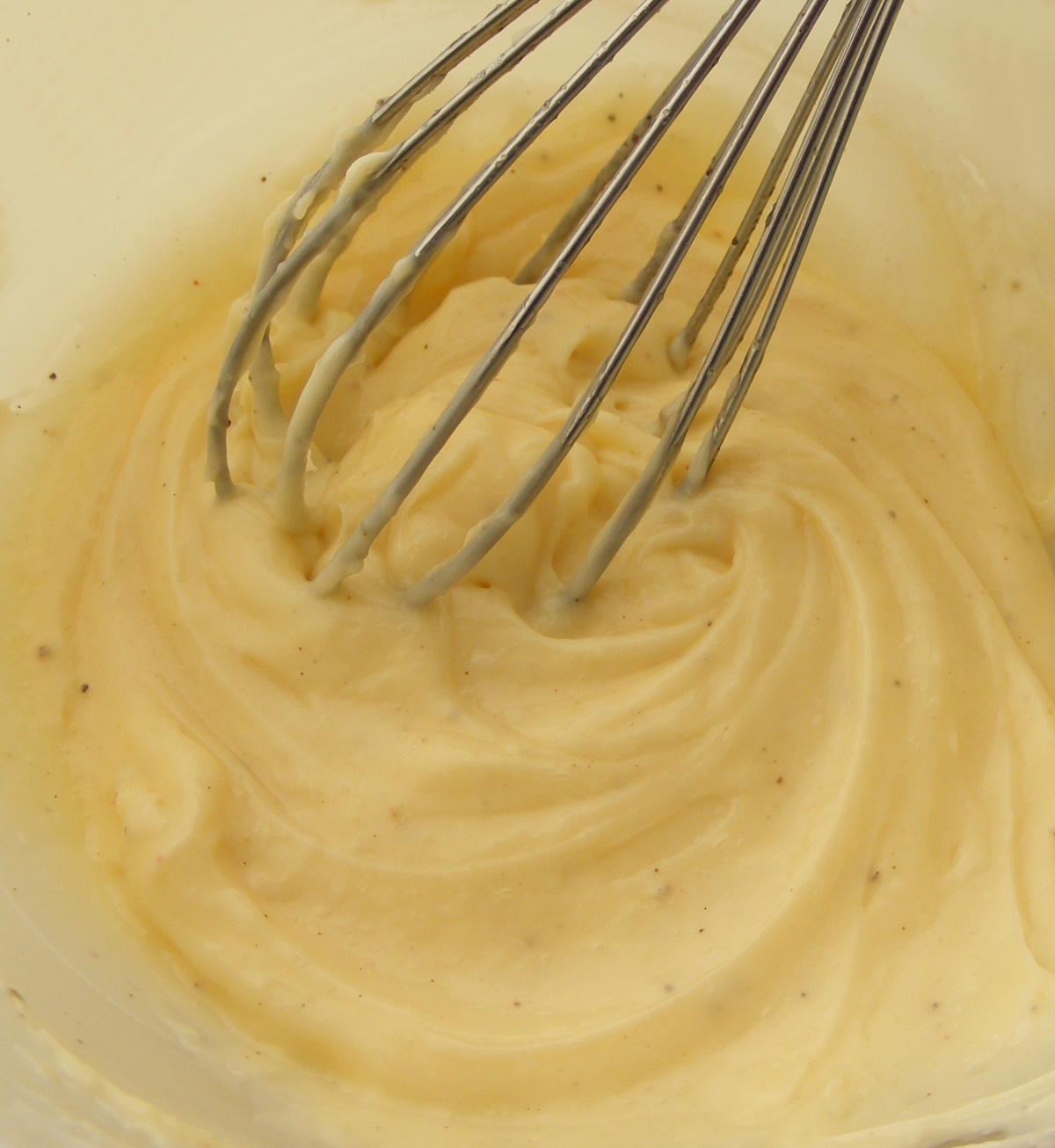
Figure 1. Mayonnaise, something that necessarily requires the emulsification of fat and water.

Emulsification is the word scientists give to mixing liquids together. Specifically, it is the process by which immiscible liquids, liquids that cannot normally mix, are mixed together. The chemical agent used is called an emulsifier. Emulsifiers are not unique to food, we use emulsifiers to clean ourselves (soap), and in order to produce medical injections.

Emulsifiers in Food

The most familiar emulsifier is probably the egg. Eggs are used as an emulsifier in everything from cakes and custard, to mayonnaise (Figure 1) and from hollandaise, to soufflés. What the egg is doing chemically is allowing the other ingredients to form a stable emulsion (mix). Interestingly, egg itself actually contains two types of emulsifier: one is protein, the other is lecithin (Figure 2). They both have chemical properties that are shared by both water and fatty substances. This helps mix things up sufficiently well to make a homogeneous mixture of water, fat and lecithin, that looks not unlike baby sick. There are others that are used regularly in cooking too. As well as the egg in mayonnaise, mustard powder is also added to many recipes. This also helps it to stay homogeneous.

Figure 2. The structure of lecithin. The blue section is water-liking.


Industrial Emulsification

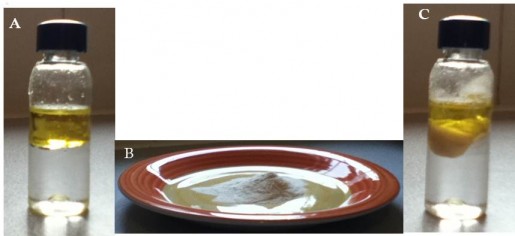
In industrial food production, several harmless emulsifiers, not common-place in the home, have been used for some time. One such is xanthan gum. The name is perhaps misleading as it is not a gum as such when bought, but an off-white powder that is usually accused of being either cocaine or flour. The usage of the word gum is perhaps clearer when we consider the properties it has on being mixed with fat and water. Figure 3 shows the transformation. Here, I include weights and volumes so you can do this yourself if you want to.

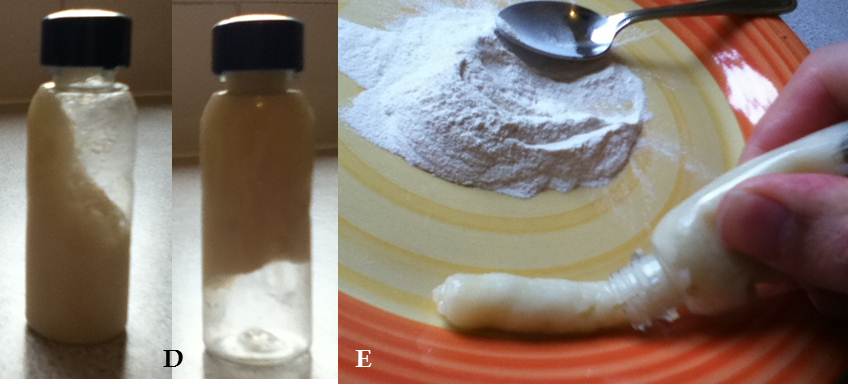
Figure 3 – mixture of oil, water and xanthan gum (E415) forming an emulsion that is also thickened. A: oil and water, B: xanthan gum as available commercially, C: xanthan gum with oil and water before shaking, D: water, oil and xanthan gum mix after shaking, showing solidification, E: solid mixture as compared to xanthan gum.

In part A we see the oil (clear yellow layer, 10 mL) above the water (colourless layer, 25 mL).  Adding the xanthan gum (B, 5 g) appears to do little initially (C), however a brief agitation of the system leads to homogenesis of the three substances (D).   Not only do we have an homogenous mixture, but also one that is thicker than it was previously – squeezing it out gives the appearance of an off-white turd (E).  Said turd goes brilliantly with a sprig of basil or rosemary and glass of chilled white Sancerre.


 “I can’t believe you like the Royal family” Sunday, Oct 9 2011 

The great disappointment I find about republicans is the absence of an intellectual approach to what they believe.  This is in stark contrast to the clarity of what they invariably say and want: get rid of the Royal Family.  This is entirely consistent with Republicans and Republican movements that leap out from history, the best examples being Oliver Cromwell, and the French revolution respectively.  However it is a philosophical dead end.  

First, there is confusion between the Royal Family and an hereditary monarchy. It is one of those distinctions that seems subtle or even semantic at first but once realised it is impossible to ignore.  It the same as mistaking a job with the person who does that job. Confusing the job or office with the person or people who hold it undoubtedly undermines the clarity of the republican argument.  Historically, there is evidence for an understanding of this distinction with the hereditary monarchy in Britain, with unpopular Kings either being left to rot and replaced (James II), or done away with and replaced (Edward II, and Charles II, albeit after a pause).  So, not only is there a reasonable basis but there is also precedent for approaching the two separately.  From my perspective, when republicans fail to make the
distinction, it sounds as though they hold an aesthetic dislike of the people involved, and are blinded by this.

Second is a positive-negative problem.  It is of course fashionable to be positive and forward-looking and all that guff.  ‘I’ has a place in the modern way of dealing with people and managing organisations as it seems to have done in eighteen-century British manners, though with rather different words.  However this polarity in intellectual argument is by far the most serious thing to undermine the republican perspective we hear about. They want to ‘get rid of the Royal family’.  Even popular references and information sources on this state it as such.  The Wikipedia page is a good example, and although this is weakened intellectually by the fact that anyone can change it, the fact is, it is the first sentence and no-one has.  In this particular case, the description has a hurried bit at the end about having non-hereditary monarchy, but even there, the wince-makingly negative stance remains.  This movement seeks to not do something. 

You may be nursing the thought that this is some sort of pseudo-royalist argument, calculated to undermine its opposition.  As it happens I do like the hereditary monarchy we have in Britain, but that is because it performs a constitutional role that I believe is important.  Of course it is not the only way of having a monarch, but whichever vehicle it is, it must be balanced by the rest of the system in which it operates.  This is rather the nub of the problem with Republican ideology: it is based on a negative.  It seems that if they wanted to, they could put forward a plan for the governance of a state that did not include an hereditary monarchy, it might well be intellectually sound.  Not only that, it might include something novel.  A shared presidency could be part of it, or as a dear old friend suggested she might like, no monarchy at all.  Her argument was that the proliferation of mass communication means that a centralising figure is no longer as important as it once was. This alone produces a mass of questions, debates and arguments on the subject, with scope for much intellectual depth.  Republicans, almost just by identifying themselves as that, count themselves out of intellectual debate on the subject at present.  Sadly. 

 E Numbers: Preservatives Saturday, Oct 1 2011 

Preserving is probably the oldest intervention humans have wanted to make to food.  That is not to say that when man first donned a loincloth and dragged his nominal wife around by her hair he was wondering how to make the butchered elk leg go an extra day, but certainly historical evidence suggests it was a present and pressing concern at least as far back as the ancients.  It does not have to be primarily a chemical process; it can be a physical one.  For example, for the last several thousand years, several types of food have been dried in order to preserve them.

Drying

The drying process can significantly extend the life of vegetable and fruit foods as well as meats. In parts of the world they even dry out tarantula spiders in order to preserve them (Figure 1).  There are several ways of drying foods.  Sunlight can be used – we have all seen, if not  bought, sun-dried tomatoes – but also wind.  Carpaccio, although it sounds like a cheap fortified wine, drunk only as shots by pissed-up Australians, was originally wind-dried Italian beef1.

Figure 1 – Tarantula spiders that are dried and eaten in some parts of the world*.

Probably the earliest attempts at chemical preservatives employed salt.  Although later mined, this was first isolated from the sea using tidal flows that filled small pools at high or possibly spring tides, and the water evaporated in the sun.  In Western Europe and other places, pork and beef were routinely packed into salt, which preserved them.  In fact this was the chief method of preserving these meats until at least the end of the middle ages. The discovery of nutmeg as a meat preservative became more widespread in use from around this time, allowing meat to be eaten all year round, but also to be taken on sea voyages.  In fact, the utility of nutmeg in particular in preserving meat was so keenly observed and was unique to it for many years that with a geographically limited supply, human conflict
resulted.  The conflict between the Netherlands and Portuguese in the 18th Century was fought more or less directly over nutmeg.  Although pork with nutmeg is a seemingly odd combination today, it is a delicious one.

What Does Drying Do, and Why Does it Work?

Drying, whether with salt or not, works in the same way that adding sugar and heating to make jam works as a method of preserving food.  You will know from experience that eating salty or very sugary (rather than just sweet) food makes one thirsty.  The same is true of microbes exposed to high concentrations of sugar or salt.  The sugar and salt draw the water out from them, too.  However when the sugar or salt content is sufficiently high, so much water is drawn out, it kills them.  This is how to spot poor-quality jam: mould will grow on it.  The same principle can be applied to dried beef: the salts and other things within the meat fibres have reached a concentration that prevents microbes from living on them.

There is a secondary reason why covering a pork joint in salt will preserve it.  It also forms a barrier between the meat and the air.  This prevents the air-borne bacteria and fungi from ever reaching the food in the first place – it is a barrier between the food and the outside world. Today the principle barriers in use are plastic films and canning, as part of sealed packaging, and so on for just this purpose.

Preservatives: The E Numbers’ Finest Hour

The E numbers we use to preserve foods are plentiful, in fact there are two groups for this job.  There are the numbers E200-299 (general preservatives) and E300-399 (anti-oxidants).  The E300s are perhaps the most interesting because of how they are misunderstood. ‘Anti-oxidants’ are, to a lot of people, something to do with hand cream and young-looking skin.  Perversely, the same chemicals that give these creams their anti-oxidant (preservative) properties are often the same ones that appear in food.  And while a bit of vitamin C (ascorbic acid, otherwise known as E300) is not going to turn a shrivelled apricot into a peachy baby’s bottom, it will delay the fats in that cream from going rancid.

If you want to test this experiment at home, take a bottle of lemon juice and a fresh apple.  Halve said apple, put the face of one half in the lemon juice and the other on a windowsill and leave for a couple of hours. Compare the state of the two after this time.

References and Notes

1     A. de Conte, ‘Amaretto, Apple Cakes and Artichokes’, Vintage Books, 2006.